Reply To: Year 9 (Grade 8) Interdisciplinary Signature Work Inquiry @ Blanchelande College
Home › Forums › Inquiry and resource design › Year 9 (Grade 8) Interdisciplinary Signature Work Inquiry @ Blanchelande College › Reply To: Year 9 (Grade 8) Interdisciplinary Signature Work Inquiry @ Blanchelande College

Notes on previous post…
By record, I mean the record of human knowledge of reality as uncovered through inquiry in the various academic disciplines (scholarship). This does not discount important insights into reality that we can gain from fiction, but this is a discussion for later.
Theologically, from a Christian and Catholic perspective, Jesus’ self-identification with Isaiah’s prophetic text could not be more attention-worthy, because in doing so, He declares Himself to be the Messiah the Jews were expecting, even though many would not realise it. His own words [as reported by Luke], then, become prophetic and eschatological, in that the values of the everlasting Kingdom of God that He has come to usher in are at odds with those of the kingdoms of this world. Moreover, His acting in and on the world is part of a Historical record that is still being written.
Laudato si’ is the most consequential Catholic social teaching since Rerum novarum (Of new things): On capital and labour (15 May 1891), and its exhortation to hear the cry of the poor and the earth links also and obviously to the Creation and Covenant in Theology. And while it will not be possible to read the entire encyclical, even in part it remains revelatory, for example
“The external deserts in the world are growing, because the internal deserts have become so vast” [quoting Benedict XVI]. For this reason, the ecological crisis is also a summons to profound interior conversion.
—
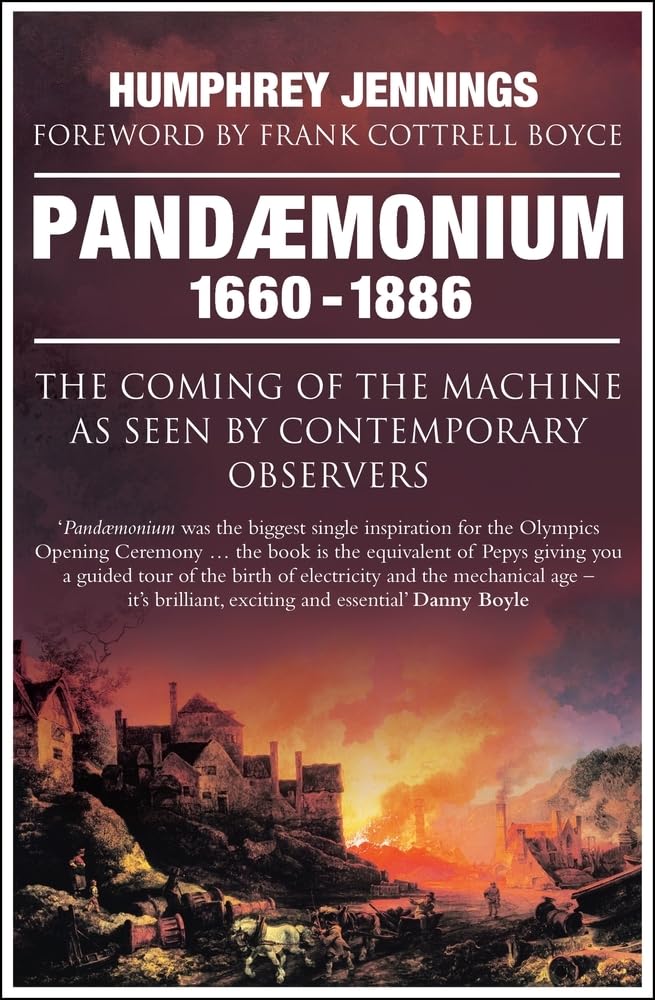
Thinking more about Blake’s London, I remembered talking with Frank Cottrell Boyce at the 25th anniversary of the extraordinary Smallbone Library at Oakham School about his involvement with the Opening Ceremony of the 2012 London Olympics Games. The other guest speaker, Huw Davies, had earlier mentioned to me that a revelatory text for him had been Pandæmonium, 1660–1886: The Coming of the Machine as Seen by Contemporary Observers, by Humphrey Jennings, which I bought. It turned out that my copy had a Foreword by Frank. Of the book, Frank has said
When I first held this book in my hand, I swear I could feel it shaking with its own internal energy.
Frank gifted a copy of the book to Danny Boyle, who said of the book
Pandaemonium was the biggest single inspiration for the Olympic Opening Ceremony…the book was the equivalent of Pepys giving you a guided tour of the birth of electricity and the mechanical age—it’s brilliant, exciting and essential.
I have now pulled my copy of Pandaemonium off its shelf, a copy that Frank was kind enough to sign, and it is full to overflowing with revelatory texts about industrialization that a full day of scouring the web did not uncover—a Godsend.
The following from Frank’s Foreword caught my eye:
Pandaemonium documents the Industrial Revolution. We’ve had another revolution since then, of course. The Opening Ceremony was an event that both celebrated and immersed itself in the digital revolution. But at its heart was that most analogue of things–a book. Only books can free us from the tyranny of the Present. The internet gives us the whole world now but it has shrunk the ‘now’ to a moment. As Danny Boyle put it, ‘ we are children of the machine age, locked inside this terrifying beast, increasingly innocent of how it makes things for us’. Only books can let us hear the voices that brought us here. Also they can be given as gifts.
In addition, then, to a revelatory text about industrialisation, it will be revelatory for Year 9 students to watch the truly extraordinary Opening Ceremony (no ads) at the start of the Inquiry, being a kind of text, as it is highly unlikely that any of them will have seen it [due to not having been born yet!].
So much more still to come.
—