Year 9 (Grade 8) Interdisciplinary Signature Work Inquiry @ Blanchelande College
Home › Forums › Inquiry and resource design › Year 9 (Grade 8) Interdisciplinary Signature Work Inquiry @ Blanchelande College
- This topic has 27 replies, 1 voice, and was last updated 1 week ago by
 Darryl Toerien.
-
AuthorPosts
-
14th June 2024 at 9:07 am #83623
A quick update.
The Year 9 Signature Work Inquiry leads to the GCSE English Language speaking and listening Non-Examined Assessment. Students are currently presenting their 5-minute speech, which is followed by a 5-minute Q&A, and I am very pleased with the quality of their work.
I am also delighted that FOSIL Signature Work Inquiry will be a timetabled subject for Year 9 next year, with an allocation of 1 lesson and 1 homework a week, which I will teach. This will allow me to develop this inquiry even more purposefully.
Meaningful curricular links with English and Geography (sustainable development) remain, and I am developing a meaningful curricular link with Theology in terms of Catholic Social Teaching.
I have produced a brief overview of the inquiry below:
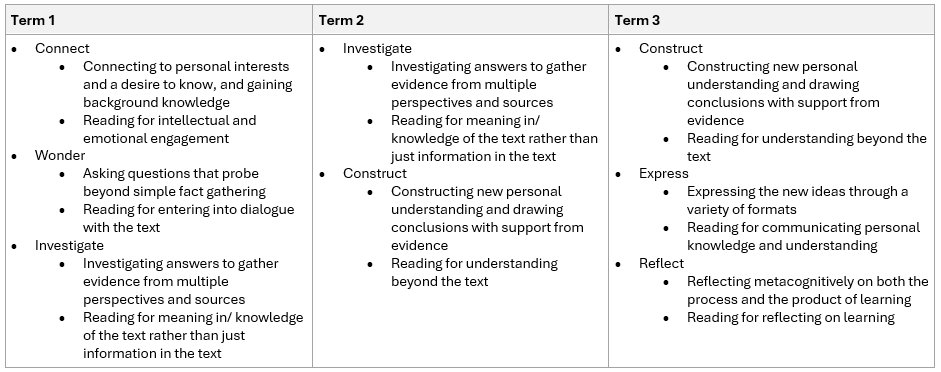
I am now working on a subject overview and description for the Curriculum Information for Lower Seniors booklet, which I will share when done.
10th December 2024 at 3:00 pm #85123I can’t believe the first term is about to end, with so much that I have yet to reflect on.
However, I can quickly share the subject overview and description for the Curriculum Information for Lower Seniors booklet (see below or download as a PDF):
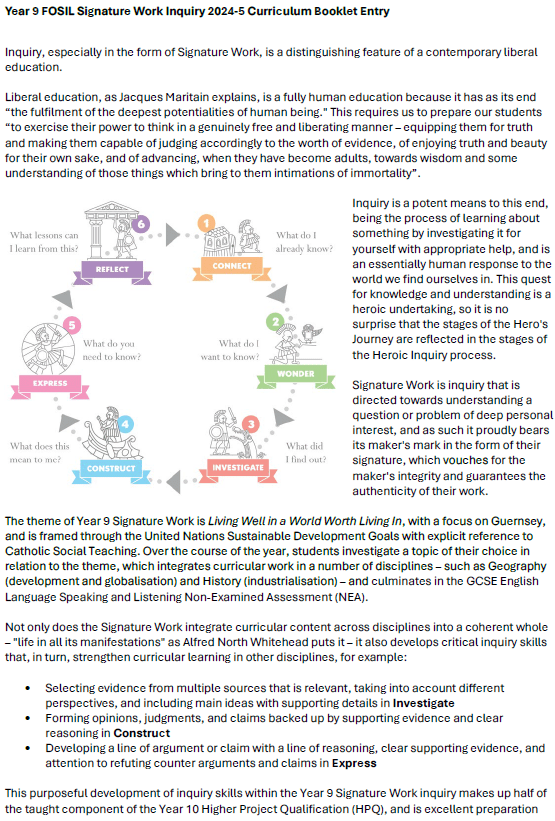

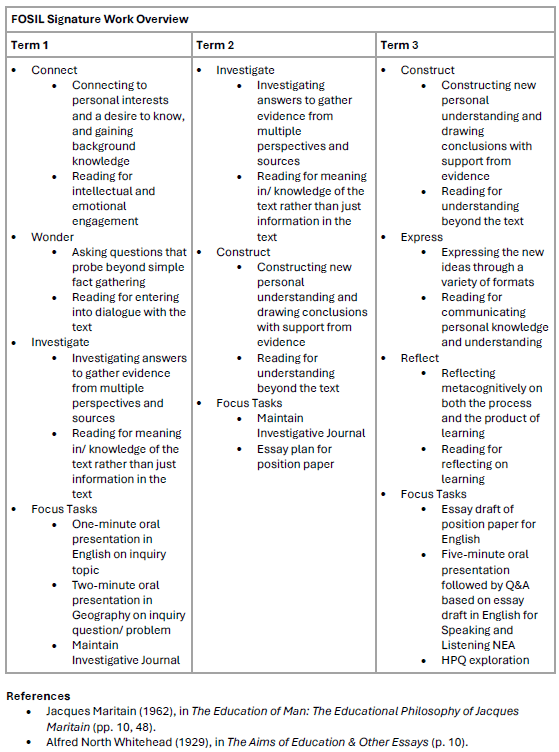 11th March 2025 at 3:05 pm #85777
In Defence of the Essay
We have reached the point in the Year 9 Signature Work inquiry where we shift our focus from thoughtful reading to thoughtful writing, which will take the form of a 750-word essay in which students will (a) clearly identify and define the problem that they intend to discuss, and (b) attempt to convince their audience of the importance and/ or severity of the problem based on evidence that they uncovered during their investigation and will present in their essay.
Why, one might ask, as some do, teach students to write an essay if AI can write a better essay? Now while there may be more to this question than at first appears, it is, as asked, a question that demands an answer.
The simple answer is that we are not, in fact, teaching students how to write an essay, but to think, with the essay in this case being a tool to think with, and a particularly powerful one at that.
This distinction may seem pedantic, but is, in fact, profound, especially as AI intrudes its way into every aspect of our lives.
As Christopher Newfield (2025) writes:
My root worry about AI has always been that while it was making machine learning better, it was also making human learning worse. I am not alone in this. Teachers, who are responsible for helping students think, were increasingly furious about what AI was doing to the student brain.
A week before ChatGPT was released, Jane Rosenzweig, director of Harvard College’s Writing Center, made what should be an obvious point: “Writing—in the classroom, in your journal, in a memo at work—is a way of bringing order to our thinking or of breaking apart that order as we challenge our ideas. If a machine is doing the writing, then we are not doing the thinking.”
…
I draw several conclusions here.
…
Second, the high-value economic benefits of AI require fully empowered human use of AI as tools. Benefits will depend on society devoting much more effort than it now does to the expansion of human capabilities, rather than seeing technology as rescuing society from the self-inflicted enshittification of its human systems. The rigourous teaching of writing and thinking is more essential than ever.
Students have now spent a term investigating a SDG-related problem that they have identified and defined, which is a distinguishing feature of Signature Work inquiry. I have been deeply impressed by how purposefully many students in this cohort have used their Investigative Journals as tools to think with.
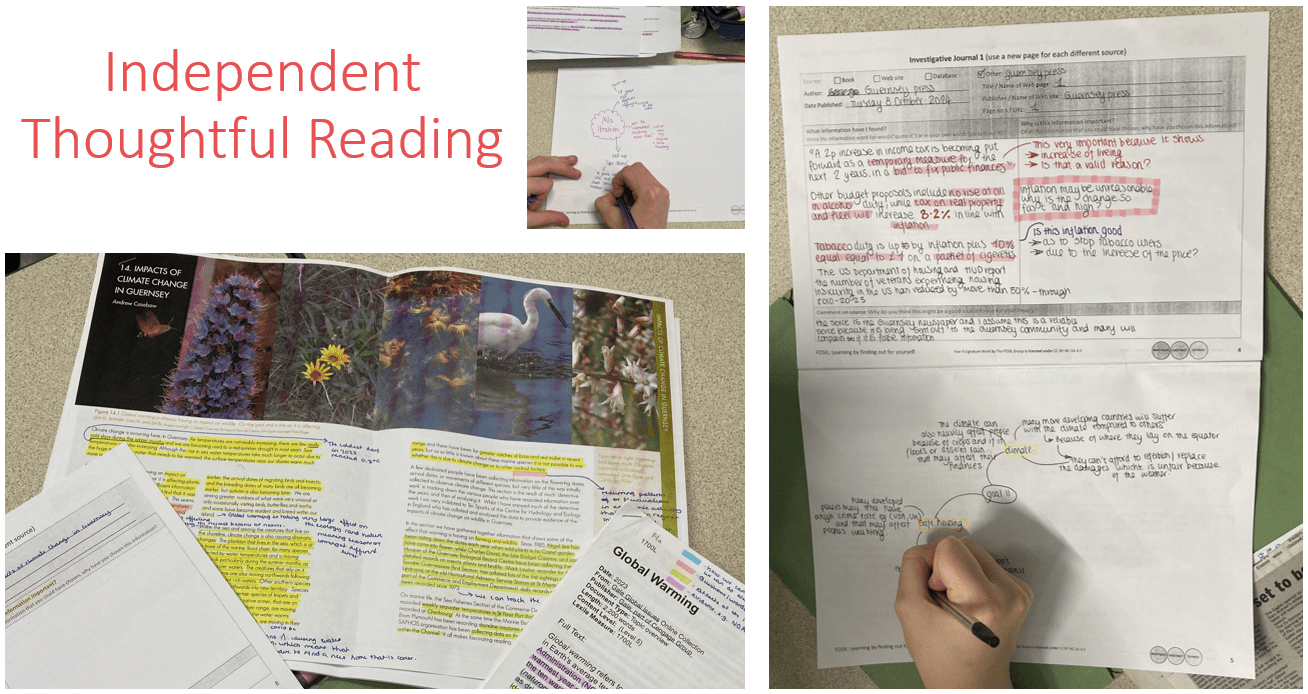
The next step, however, is daunting, even for university-level students, which is why there is real value in helping students with this in school. As Newfield (cited above) explains:
I learned during my decades of teaching university-level writing that students can mostly find a general topic that interests them. But they struggle with the next question: what do you want to say about your topic? What’s your thesis, your claim, about it? This stage turns out to be very hard, and the simple reason is that it’s where independent thinking has to happen. It’s where the student diverges, however slightly, from what has already been said. If a GPT product is available, the student—or anyone, myself included—will be tempted to use it to skip this thinking stage.
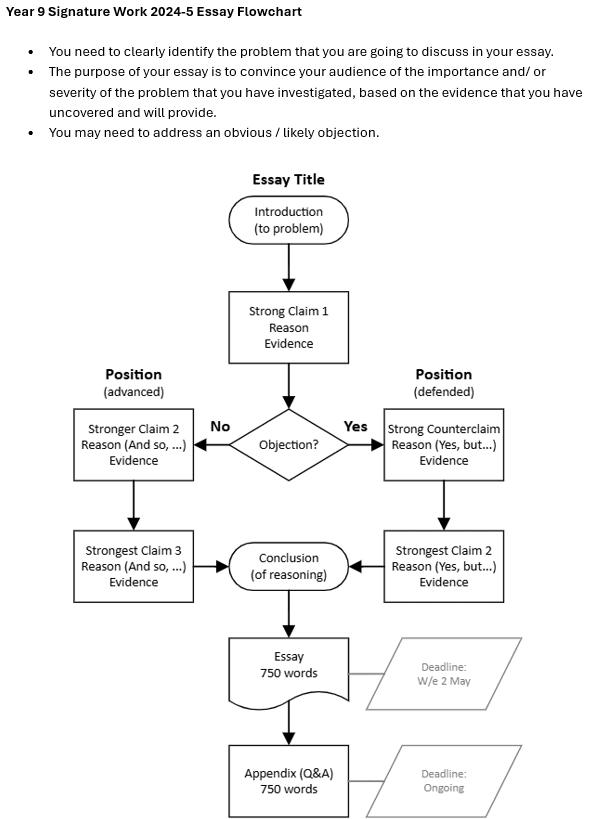
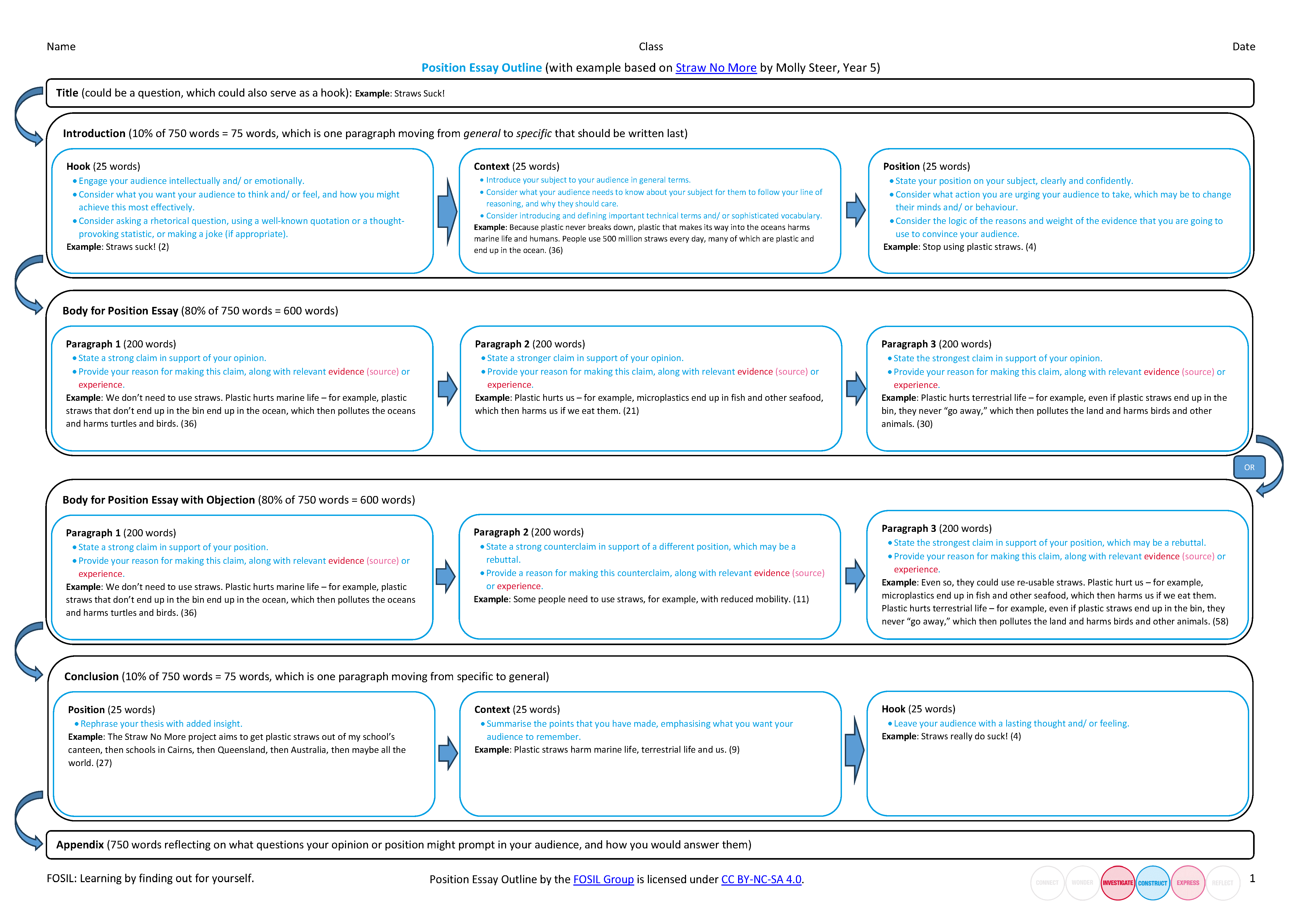
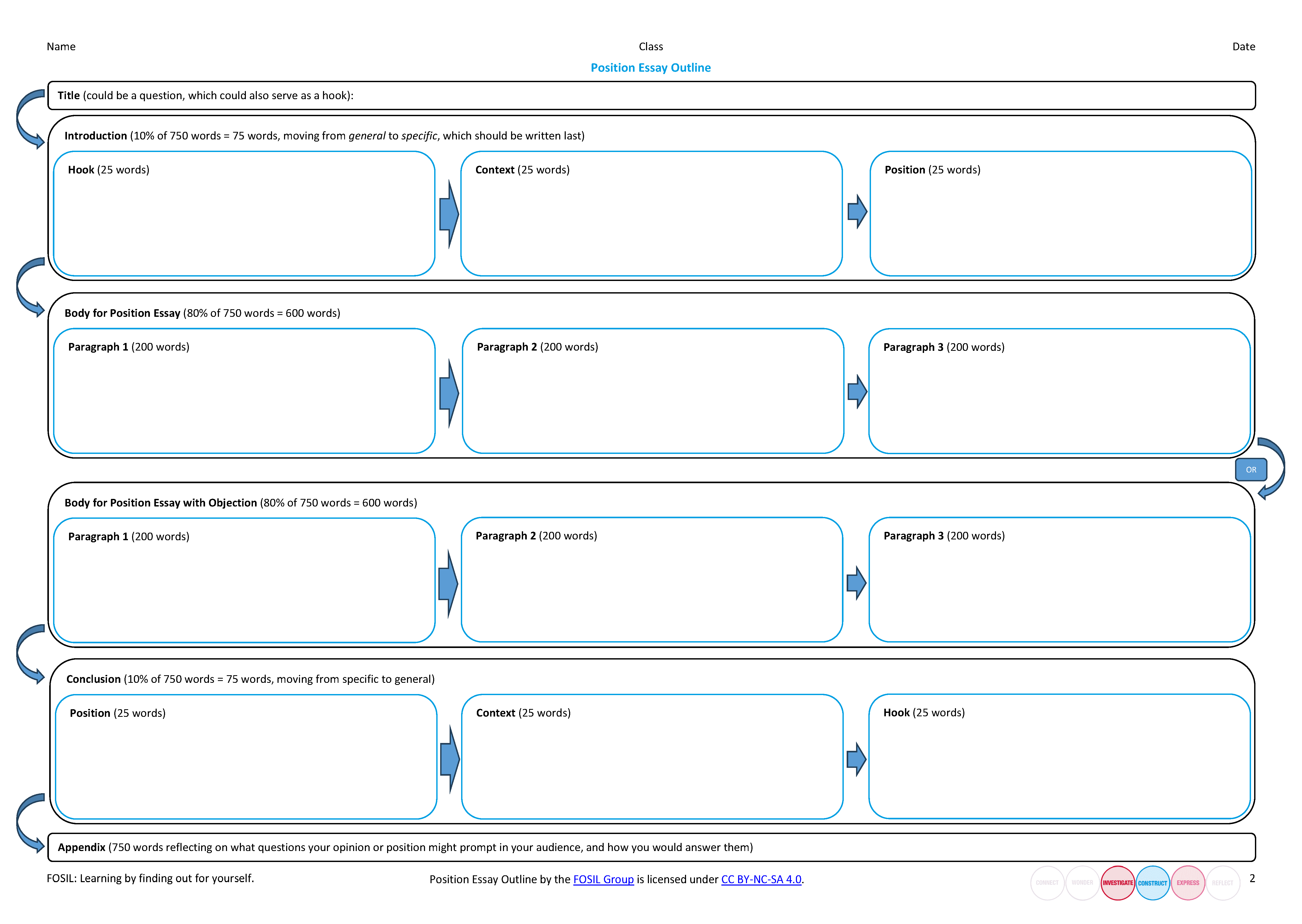
To help students with this last year, I developed the Opinion Essay and Position Essay flowchart and graphic organiser (see post #83043 above). This year I have simplified the flowchart and graphic organiser slightly (see below), and also added an example to the graphic organiser based on the Straw No More presentation by Molly Steer at TEDxJCUCairns (2017), which we looked at in class.
This is the critical moment, as Newfield highlights above, when students become more fully themselves, or less, as they face twofold temptation of letting the machine [and its programmers] think for them and speak for them–as Janet Salmons (2025, emphasis added) warns, “the implicit message [of AI offering to (re)write for you] is less than subtle: use the words we tell you to use, in the style we tell you to use, to say what we tell you to say, in the voice we tell you to use,” which is bringing about a “‘flattening’ of contemporary writing.” This is when I must trust that I have sufficiently “encouraged [my] students to engage in the process of acquiring knowledge, which is a very difficult process, [without which] all you get is memorisation and reproduction in tests” (Young, 2022), or in this case, copy & paste. This encouragement to engage–to Connect–takes time and energy, to be sure, but time and energy well spent on enabling my students to develop as engaged and empowered inquirers, increasingly willing and able to learn for themselves.
My confidence is high.
References
- Newfield, C. (2025, March 4). The Fight About AI. Retrieved from Independent Social Science Foundation: https://isrf.org/blog/the-fight-about-ai
- Salmons, J. (2025, January 28). Finding Your Voice in a Ventriloquist’s World – AI and Writing. Retrieved from The Scholarly Kitchen: https://scholarlykitchen.sspnet.org/2025/01/28/guest-post-finding-your-voice-in-a-ventriloquists-world-ai-and-writing/
- Young, M. (2022, September 21). What we’ve got wrong about knowledge & curriculum. (G. Duoblys, Interviewer) Tes Magazine.
24th June 2025 at 1:08 pm #86956On Thursday, 19 June, we held our third annual Year 9 Signature Work Inquiry Celebration.

As I explained to parents, the Signature Work poster is similar to an article’s Abstract, in that it both summarises a larger body of work and reflects a learning journey that is itself embodied and situated.
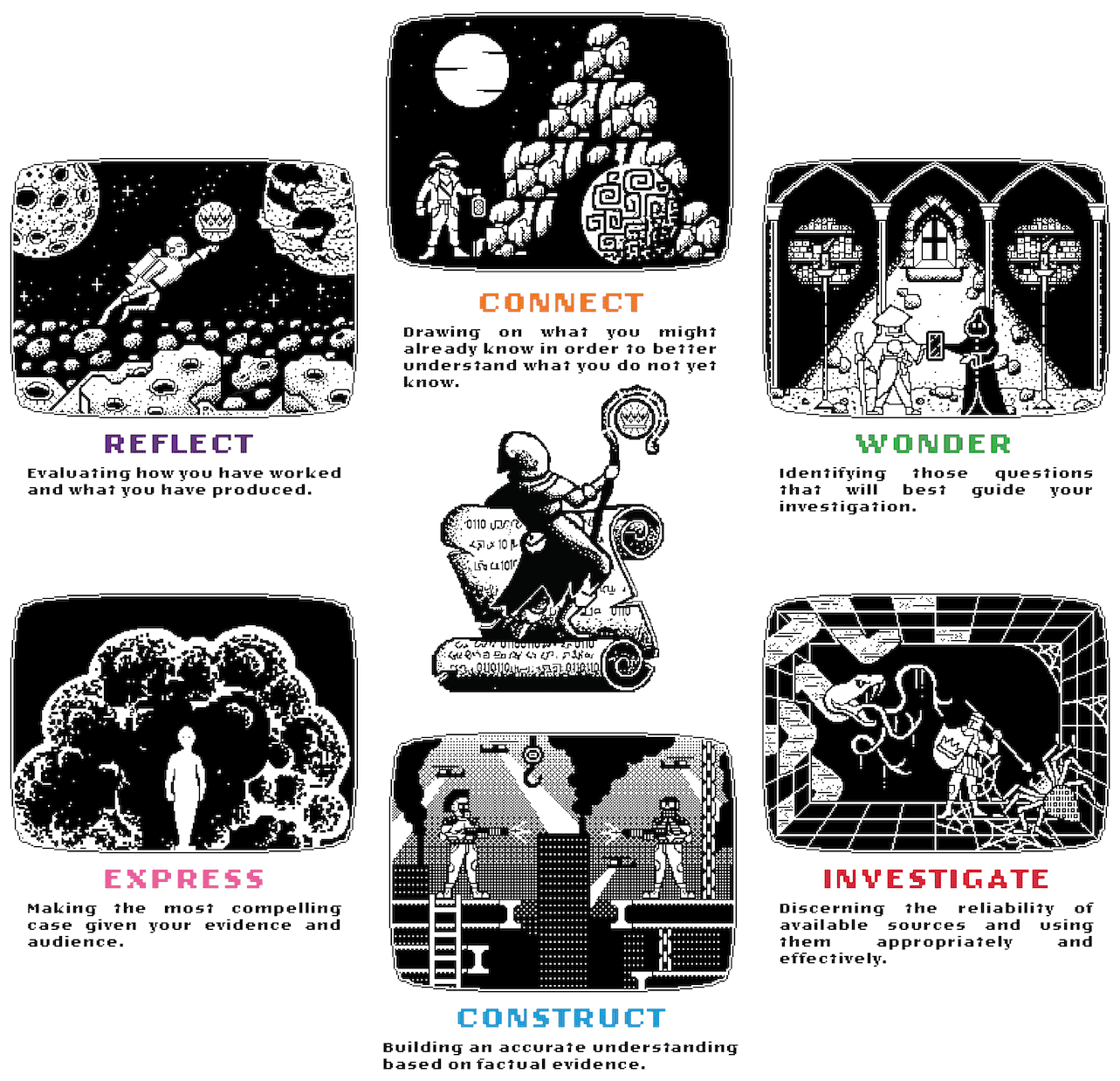
This year I gave parents an overview of what this learning journey entailed: deeply thoughtful reading into a personally-chosen topic related to the theme; a 1-minute speech in English; a 2-minute speech in Geography; a 750-word essay plan overview; an essay plan; a handwritten draft essay; a typed re-draft; a typed re-draft in response to feedback, and; cue cards for the 5-minute speech in English.

As is customary, one student was chosen to represent Year 9 with their speech, and this year we could not be prouder of Flo.

 13th March 2026 at 3:07 pm #89616
This academic year, we switched from 35-minte lessons to 50-minute lessons. This meant that the timetable was not able to accommodate the Signature Work as a separate subject, which was re-embedded in English, with a time-tabled allocation of one lesson and one homework per week. This, in turn, necessitated refining the Signature Work while also redeveloping it. This new format also meant that we were ready for the English speeches by the end of February, rather than the end of June, and we celebrated the Signature Work on Monday evening, 9 March.
While there is much to share about refinements to this Signature Work, and important insights gained, I am pressed for time at this moment. However, the celebration was extraordinary, and I share below the Library News blog post about the event, and my PPT presentation (with notes on slides 3, 11 and 21).
—
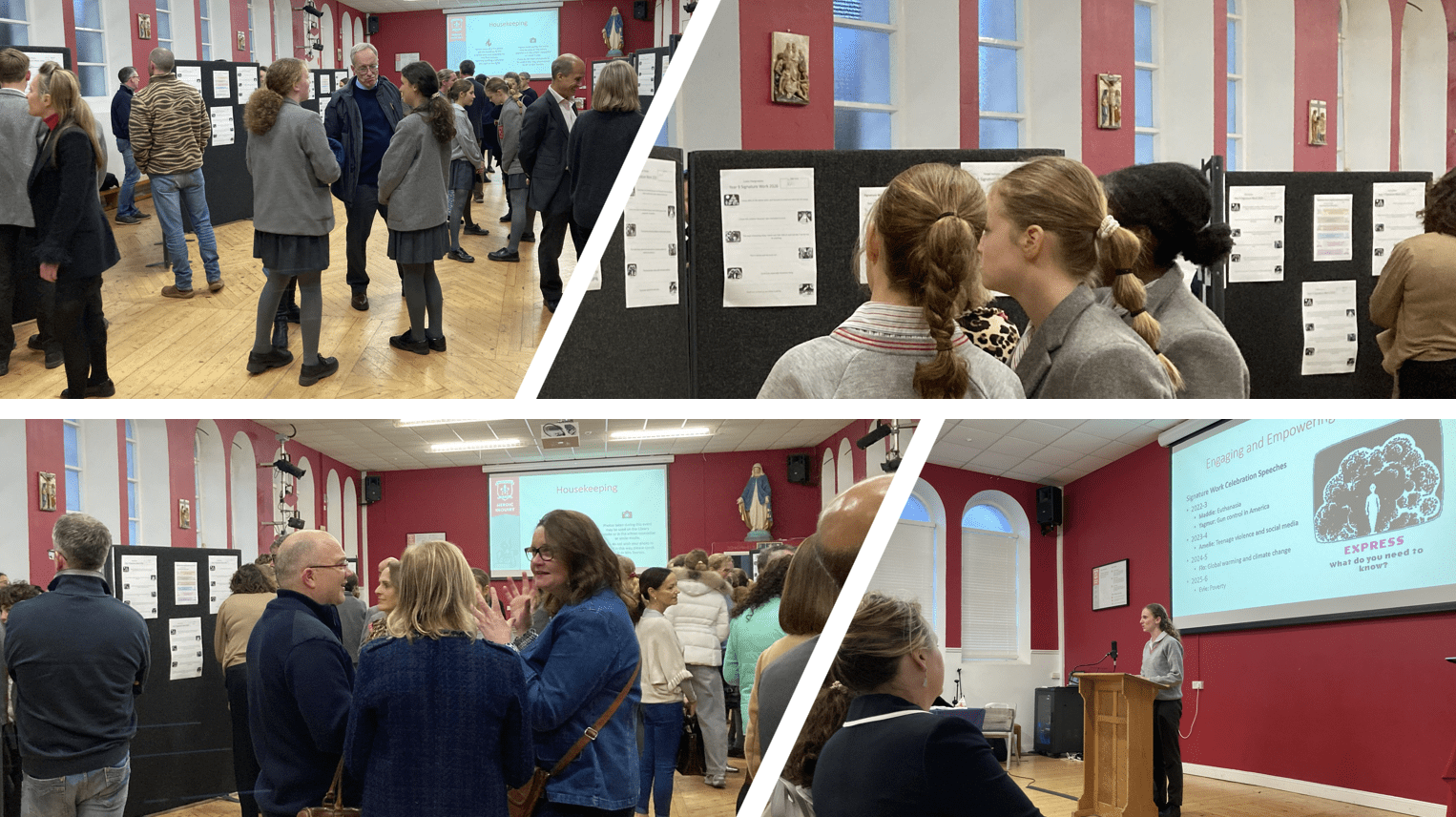
On Monday 9 March, we celebrated the conclusion of the Year 9 Signature Work Inquiry, which is an independent exploration of a topic related to the theme of Planet Guernsey: Living Well in a World Worth Living in. The Signature Work, which is framed through the United Nations Sustainable Development Goals, is embedded in English, develops curricular links with Geography and Theology, and culminates in a presentation that includes a substantial written and spoken component. The spoken component serves as final preparation for their GCSE English Language Speaking and Listening assessment, which students complete in Year 9. The Signature Work also serves as essential preparation for the inquiry-based Higher Project Qualification (HPQ), which students may apply to do in Year 10, and which counts as half a GCSE.
As is customary, one student was chosen to deliver their speech to parents and guests on behalf Year 9, which is always a highlight of the evening. This year, Evie powerfully addressed the problem of poverty in a speech that was all the more thought-provoking and challenging for being so quietly-impassioned. The other highlight of the evening is the opportunity to discuss their Signature Work with students, which is summarized in a poster. Students will be delighted to know that Mr Miller, Head of History, who attends the Celebration each year, remarked on the impressive depth of thought that had gone into this year’s posters.
Well done to Evie and all of Year 9 for embodying the joy of independent learning, and for giving voice to “the cry of the earth and the poor” (Pope Francis in Laudato si’).
 2nd April 2026 at 11:40 am #89774
Insight is the endpoint of a long-term iterative process (Syed, 2015), but further, deeper insight may be gained through further iteration. This is the case with insight into what we are trying to achieve through inquiry, and, in this case, specifically Signature Work inquiry in Year 9.
The Year 9 Signature Work inquiry, you will recall, is embedded in English. The most obvious reason for this is that it serves as preparation for the GCSE English Language Speaking and Listening NEA. However, the integration with English — and, indeed, all academic subjects/ disciplines — is more profound.
Paulo Freire, in The importance of the act of reading (1983, p. 5), writes that
reading the world precedes reading the word, and the subsequent reading of the word cannot dispense with continually reading the world.
This, essentially, is inquiry — coming to know and understand the world and ourselves in it, through reading the world (experience) and reading the word (record), as the basis for responsible participation in community.
Now, there is more to be said about reading the world through the various academic subjects/ disciplines, which I will return to. As for reading the word, Eric O. Springsted, discussing Simone Weil’s notion of attention in Attention, Availability, and the Reading of Books, writes that
if the development of attention — making oneself available — is what is most important for a student, then it is clear that the teacher’s most important task is to make that possible. No one can teach attention, just as one cannot teach insight. It has to come from within the student. But one can give students texts that are worthy of attention, that can be revelatory to them.
The question, then, in English as it is in the other academic subjects/ disciplines, is what are the revelatory texts that we are enabling our students to read? More to follow on this, too.
—
References
- Freire, P. (1983). The importance of the act of reading. Journal of Education, 165(1), 5–11. tinyurl.com/38x8etpj
- Springsted, E. O. (2025, January 18). Attention, availability, and the reading of books. Attention. https://tinyurl.com/3buzrh9y
- Syed, M. (2015, November 14). Viewpoint: How creativity is helped by failure. BBC News. https://tinyurl.com/35929aaw
13th April 2026 at 8:32 am #89878It occurs to me that I have not posted here our definition of Signature Work inquiry:
An inquiry-based, interdisciplinary exploration of a significant problem, issue or question that is personally identified and defined by the student, and that involves substantial, developmentally appropriate reading, writing and reflection, and culminates in an authentic product that is publicly celebrated—called such to reflect the high level of personalisation and individual initiative involved, which makes the work authentically, uniquely and proudly their own.
By interdisciplinary we mean making meaningful curricular links between subjects explicit—for example, choosing to frame the Year 9 English Language speeches through the UN Sustainable Development Goals establishes a link to work on development in Geography and Catholic Social Teaching in Theology. In addition to creating a richer web of learning, this strengthens the perception and experience of knowledge as a meaningful and coherent whole.
11th June 2026 at 12:11 pm #90720Next year will be the first year since starting the Year 9 Signature Work at Blanchelande in 2021-2 that the format will be unchanged (i.e., the timetable allocation will remain exactly the same), which means that I can focus solely on refining the Inquiry rather than on refining it while also needing to revise it at the same time. So, thinking ahead…
Paulo Freire, in The importance of the act of reading (1983, p. 5), writes that
reading the world precedes reading the word, and the subsequent reading of the word cannot dispense with continually reading the world.
This is inquiry—coming to know and understand reality through learning to accurately and dynamically read the world (experience) and the word (record). Moreover, inquiry is communal. Elsewhere (1970/2005, p. 72), Freire writes that
apart from inquiry, apart from the praxis, individuals cannot be truly human, [because] knowledge emerges only through invention and re-invention, through the restless, impatient, continuing, hopeful inquiry human beings pursue in the world, with the world, and with each other.
Or, writing more than 50 years later, as Jonathan Rauch (2021, p. 4) puts it, while
acquiring knowledge [necessarily involves] personal struggles to find the right questions and assemble mosaic tiles of information to tell the tale coherently, [acquiring knowledge] is a conversation, not a destination…a journey we take together, not alone, [because] others are always involved.
And, as Douglas Knight (1968, p. viii) reminds us, these others
are not limited by our normal boundaries of time, space, and social or economic level (although they can be)
because of the record.
Reading the world necessarily precedes reading the word, because we live, move and have our being in the world before we learn to read about the world, and even after we have learnt to read about the world, we must return to living, moving and having our being in the world. However, because we act in the world and on the world, we change the world even as the world changes us. In our acting in and on the world, we do so not just as thoughtless beasts—although we can, and sometimes do—but also as [deeply] thoughtful beings. It is precisely in our capacity for thoughtful action that reading the word becomes decisive, because the word enlarges the world of possibilities open to us, and in this sense Ludwig Wittgenstein is correct that the limits of our language are the limits of our world. Or, as Iris Murdoch is said to say in Iris (2001),
if one doesn’t have words, how does one think?
Now, concerning the reading of the word, Eric O. Springsted, discussing Simone Weil’s notion of attention in Attention, availability, and the reading of books (2025), writes that
if the development of attention—making oneself available—is what is most important for a student, then it is clear that the teacher’s most important task is to make that possible. No one can teach attention, just as one cannot teach insight. It has to come from within the student. But one can give students texts that are worthy of attention, that can be revelatory to them.
The challenge for us, then, is to provide students with and also enable them to find words (texts) that are worthy of their attention/ revelatory to them throughout the inquiry process, which, at a certain point—between Construct and Express—become their own. For their own words to become revelatory to them, and to others, they must come by stages to know what they think by striving to see what they say (attributed by Graham Wallas to an anonymous girl).
Reading [and writing—still to come] throughout the inquiry process:
- Connect | Reading to engage with the text intellectually and emotionally
- Wonder | Reading to enter into dialogue with the text
- Investigate | Reading to make sense of/ know the text (what is the text saying to me?)
- Construct | Reading to find meaning in/ understand the text (what does the text mean to me?)
- Express | Reading to communicate personal knowledge and understanding
- Reflect | Reading to reflect on learning
The theme of this Signature Work is Planet Guernsey: Living well in a world worth living in, and it is framed through the United Nations Sustainable Development Goals (SDGs). It is embedded in the Year 9 English curriculum—which includes modernist/ modern poetry, which I will return to—and it develops meaningful curricular links with Geography (World Development and Globalisation), History (Industrialisation) and Theology (Creation and Covenant / Catholic Social Teaching).
Finding suitable revelatory texts for Connect is challenging, mainly due to a combination of students not having much, if any, background knowledge about the SDGs and there being a wide ability range. Furthermore, as time is limited, we need to be purposeful in helping students to identify an SDG, and then a focus within that SDG, to investigate. This year, we developed a Theology Inquiry for Year 8, titled Who is the Messiah that the Jews were expecting? (LibGuide link), which worked very well. I am thinking, therefore, of starting with Jesus inaugurating his ministry by identifying himself with Isaiah’s prophetic text (Luke 4:18-19 referencing Isaiah 61:1-2, HCSB), which all students will be familiar with:
The Spirit of the Lord is on Me,/ because He has anointed Me/ to preach good news to the poor./ He has sent Me/ to proclaim freedom to the captives/ and recovery of sight to the blind,/ to set free the oppressed,/ to proclaim the year of the Lord’s favor.
This concern for the poor in the broadest sense of the word provides a strong link to Pope Francis’s second encyclical, Laudato si’ (Praise be to You): On care for our common home (24 May 2015), which exhorts us “to hear the cry of the poor and the earth” (emphasis added), and which took shape alongside the SDGs (29 September 2015).
I am also thinking of using a poem like William Blake’s London (1794), which, although not modernist (1890-1950), sheds a bleak light on the urbanisation accompanying the unfolding Industrial Revolution (1760-1840):
I wander through each chartered street,/ Near where the chartered Thames does flow,/ A mark in every face I meet,/ Marks of weakness, marks of woe.// In every cry of every man,/ In every infant’s cry of fear,/ In every voice, in every ban,/ The mind-forged manacles I hear:// How the chimney-sweeper’s cry/ Every blackening church appals,/ And the hapless soldier’s sigh/ Runs in blood down palace-walls.// But most, through midnight streets I hear/ How the youthful harlot’s curse/ Blasts the new-born infant’s tear,/ And blights with plagues the marriage hearse.
Some work for me still to do here, and I will reach out to my colleagues in English for suggestions.
More to follow.
13th June 2026 at 11:50 am #90767Notes on previous post…
By record, I mean the record of human knowledge of reality as uncovered through inquiry in the various academic disciplines (scholarship). This does not discount important insights into reality that we can gain from fiction, but this is a discussion for later.
Theologically, from a Christian and Catholic perspective, Jesus’ self-identification with Isaiah’s prophetic text could not be more attention-worthy, because in doing so, He declares Himself to be the Messiah the Jews were expecting, even though many would not realise it. His own words [as reported by Luke], then, become prophetic and eschatological, in that the values of the everlasting Kingdom of God that He has come to usher in are at odds with those of the kingdoms of this world. Moreover, His acting in and on the world is part of a Historical record that is still being written.
Laudato si’ is the most consequential Catholic social teaching since Rerum novarum (Of new things): On capital and labour (15 May 1891), and its exhortation to hear the cry of the poor and the earth links also and obviously to the Creation and Covenant in Theology. And while it will not be possible to read the entire encyclical, even in part it remains revelatory, for example
“The external deserts in the world are growing, because the internal deserts have become so vast” [quoting Benedict XVI]. For this reason, the ecological crisis is also a summons to profound interior conversion.
—
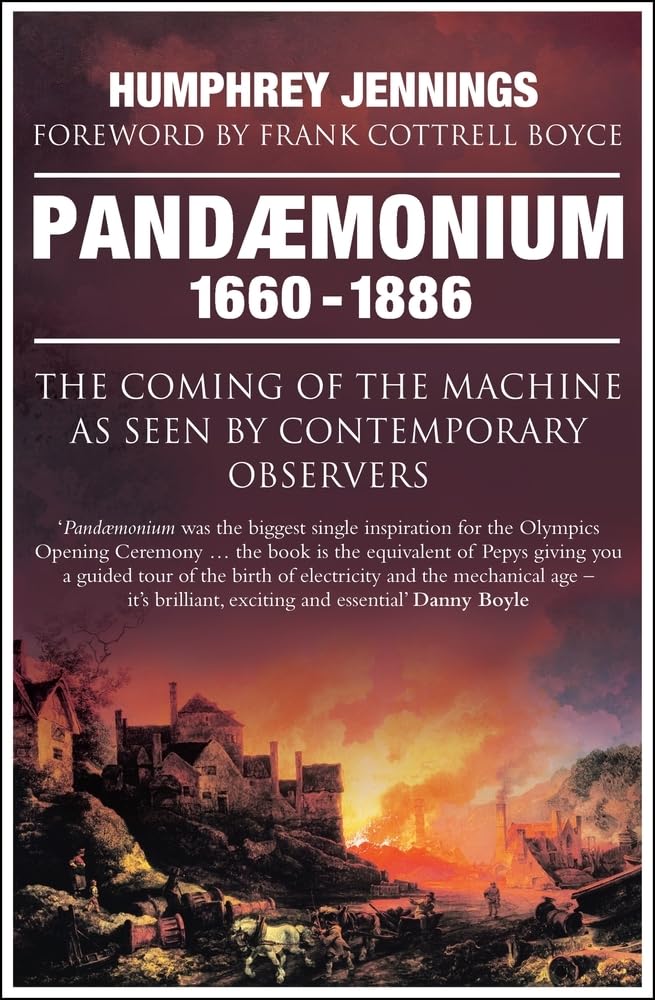
Thinking more about Blake’s London, I remembered talking with Frank Cottrell Boyce at the 25th anniversary of the extraordinary Smallbone Library at Oakham School about his involvement with the Opening Ceremony of the 2012 London Olympics Games. The other guest speaker, Huw Davies, had earlier mentioned to me that a revelatory text for him had been Pandæmonium, 1660–1886: The Coming of the Machine as Seen by Contemporary Observers, by Humphrey Jennings, which I bought. It turned out that my copy had a Foreword by Frank. Of the book, Frank has said
When I first held this book in my hand, I swear I could feel it shaking with its own internal energy.
Frank gifted a copy of the book to Danny Boyle, who said of the book
Pandaemonium was the biggest single inspiration for the Olympic Opening Ceremony…the book was the equivalent of Pepys giving you a guided tour of the birth of electricity and the mechanical age—it’s brilliant, exciting and essential.
I have now pulled my copy of Pandaemonium off its shelf, a copy that Frank was kind enough to sign, and it is full to overflowing with revelatory texts about industrialization that a full day of scouring the web did not uncover—a Godsend.
The following from Frank’s Foreword caught my eye:
Pandaemonium documents the Industrial Revolution. We’ve had another revolution since then, of course. The Opening Ceremony was an event that both celebrated and immersed itself in the digital revolution. But at its heart was that most analogue of things–a book. Only books can free us from the tyranny of the Present. The internet gives us the whole world now but it has shrunk the ‘now’ to a moment. As Danny Boyle put it, ‘ we are children of the machine age, locked inside this terrifying beast, increasingly innocent of how it makes things for us’. Only books can let us hear the voices that brought us here. Also they can be given as gifts.
In addition, then, to a revelatory text about industrialisation, it will be revelatory for Year 9 students to watch the truly extraordinary Opening Ceremony (no ads) at the start of the Inquiry, being a kind of text, as it is highly unlikely that any of them will have seen it [due to not having been born yet!].
So much more still to come.
—
 14th June 2026 at 12:18 pm #90769
G.K. Chesterton in Frank Cottrell Boyce’s Foreword to Pandæmonium, 1660–1886: The Coming of the Machine as Seen by Contemporary Observers, by Humphrey Jennings (1985/2012),
The World is not perishing from lack of wonders, it is perishing from lack of wonder.
Also, Frank continues
Progress is not motivated by money. Progress comes from those who are happy to embark on a course of action without quite knowing where it will lead, without doing a feasibility study, without fear of failure or too much hope of reward.* The engine of of innovation is reckless generosity…National identity is not a settled thing—it’s not a typical dish or a national costume. A nation is what Philip Larkin would call ‘a frail, travelling coincidence’—a ragtag of people on a journey together…
*C.S. Peirce (1955),
Upon this first, and in one sense this sole, rule of reason—that in order to learn you must desire to learn, and in so desiring not be satisfied with what you already incline to think [judging according to the weight of evidence]—there follows one corollary…Do not block the way of inquiry!
17th June 2026 at 2:19 pm #90821In addition to the Theology inquiry for Year 8 mentioned in this post above–Who is the Messiah that the Jews were expecting? (detailed LibGuide link)–that we introduced this year, we have also developed the following Year 8 inquiries:
- English ~ Gothic Literature (basic LibGuide link)–now in its third year
- Geography ~ Extreme Weather (detailed LibGuide link)–new this year
- Mathematics ~ International Mathematicians (detailed LibGuide link)–now in its fourth year, with Maths goes to the Movies new this year
Edit: These Year 8 students have also experienced the very sophisticated Year 6 (Grade 5) Interdisciplinary Signature Work Inquiry @ Blanchelande College (Forum Topic)–now in its fourth year–which also has some excellent Resources (Search by Title “Cool Water”) and a detailed LibGuide.
I mention this for two reasons:
Firstly, these Year 8 students will arrive into Year 9 as significantly more engaged and empowered inquirers.
Secondly, the English Gothic Literature inquiry results in students writing their own Gothic short stories, drawing on the literary techniques they uncovered during the inquiry, which we then publish and make available in the Library. This is such a powerful experience for the students, and these anthologies are some of our most popular books. What I have noticed this year, possibly partly due to the point above, is how purposefully and enthusiastically students across all three classes are approaching their short stories, with a much greater sense that they view themselves as writers. I am very excited about developing this aspect of inquiry more purposefully with them in Year 9.
9th September 2026 at 12:26 pm #92340This year I had a 15-minute session with Year 9 students—in Forms rather than teaching Sets—on the first day of term as part of their Academic Induction programme, which was helpful.
I re-read Whitehead’s (1929) The aims of education over the summer. In it he says that
“From the very beginning, the child should experience the joy of discovery. The discovery which they have to make, is that general ideas give an understanding of that stream of events which pours through their life, which is their life.” (emphasis added)
This is important for three reasons.
Firstly, from the perspective of the Library. This brings to mind Douglas Knight’s (1968) observation that the two major and unique functions of a library are that it is space for (1) the meeting of mind and ideas, and (2) the development of ideas in the mind. Moreover, as Ruth Anne Davies (1969/1979) observes in her landmark work, The school library media program: Instructional force for excellence,
because “the library…program and the educational program are interdependent and inseparable…perspective in viewing the function and role of the school library…program [must begin] logically by building a historical understanding of education itself.”
This, then, establishes a deep and vital link between the library programme and the educational programme.
Secondly, from the perspective of the Year 9 Signature Work, which is centrally important to the Library’s inquiry-centred instructional programme (see IFLA School Library Guidelines), and by extension that of the College. The Signature Work consists of a number of lessons that follow a logical order, in that they step students through the stages of the inquiry process. During the course of these lessons, students are introduced to a number of ideas that might qualify as “general ideas [that] give an understanding of that stream of events which pours through their life, which is their life”—work still to be done here, also in relation to Willard’s (2002) four main factors in the realm of thought (ideas, images, information and thinking). However, I had not considered these [general] ideas as an organising principle, in that each lesson could/ should be centred on one—or more, if necessary to move the inquiry forward—clearly defined ideas. For example:
- Lesson 00 (Induction)
- Idea: The only true measure of success is how well you deal with reality [which includes your Signature Work] (Willard)
- Idea: Think globally and act locally
- Lesson 01
- Idea: Reading the world (experience) precedes reading the word (record of experience), after which you cannot read one without also reading the other (Freire)
- Idea: In order to learn you must desire to learn (Peirce), and because it is always wrong to believe something without sufficient evidence (Clifford), you will need to provide evidence of your desire to learn [for example, annotating your independent reading]
- Lesson 02
- Idea: …
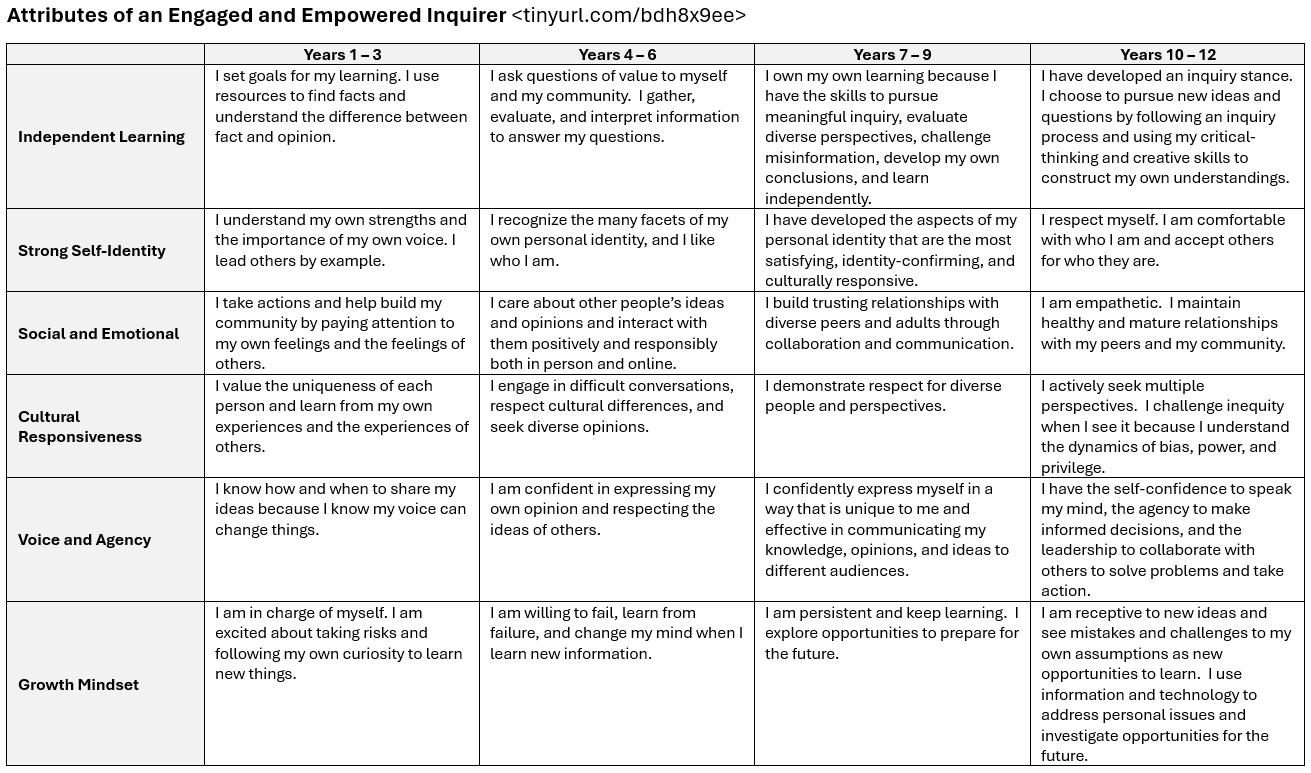
Thirdly, in relation to the College’s values, which are (1) Joy in Learning, (2) Joy in Service, and (3) Joy in Faith. The joy of discovering that certain ideas help us to make sense of reality—which is a central feature of our definition of inquiry*—not only links the library’s programme with the College’s educational programme, but also with one of its core values.
I will update further as Lesson 01 takes shape for Monday, and also share Lesson 00 (Induction).
—
*Inquiry is a stance of wonder and puzzlement that gives rise to a dynamic process of coming to know and understand the world and ourselves in it as the basis for responsible participation in community.
8th October 2026 at 10:24 am #92968Lee FitzGerald, Editor of ACCESS, the national journal of the Australian School Library Association, has asked me to contribute an article on this Signature Work inquiry to her new feature series, Inquiry in Practice.
For this article, I will develop my reflections on the first six weeks of this inquiry, which I will share here shortly.
-
AuthorPosts

- You must be logged in to reply to this topic.