Reply To: Defining “Research” and “Advanced” and “Inquiry”
Home › Forums › The nature of inquiry and information literacy › Defining “Research” and “Advanced” and “Inquiry” › Reply To: Defining “Research” and “Advanced” and “Inquiry”

Continued from post above…
The reason why it is necessary to make a clear distinction between inquiry and research–and, more narrowly, information literacy–is precisely because inquiry is a process through which we learn important disciplinary/ subject content. This process includes research and information literacy–mainly in, but not limited to, Investigate and Express–but is not reducible to research or information literacy. This means that when we are talking with our classroom-based colleagues about inquiry, we are talking with them about acquiring disciplinary/ subject content knowledge, which is their primary concern. Whereas, when we are talking with our classroom-based colleagues about research, or information literacy (or media and information/ digital/ AI/ … literacy), we are talking about part of the process of acquiring disciplinary/ subject content knowledge, and one that, moreover, competes for precious curriculum time for the acquisition of disciplinary/ subject content knowledge, which, most likely, is focussed on the memorisation of information for reproduction in tests. It is a question, then, of trying to convince our classroom-based colleagues of approaching the acquisition of disciplinary/ subject content knowledge through inquiry, or of trying to convince them give up precious curriculum time for something that only partly addresses the acquisition of disciplinary/ subject content knowledge. This may seem like a minor distinction, but, in reality, it makes the world of difference to collaboration between the library and the classroom.
In discussing inquiry as a preferable way to approach the acquisition of disciplinary/ subject content knowledge–one that goes beyond memorisation and reproduction in tests, and is more expansive than research and information literacy–we have found the inquiry process skill sets especially helpful, which were introduced in the 2019 re-imagining of the ESIFC continuum of skills.
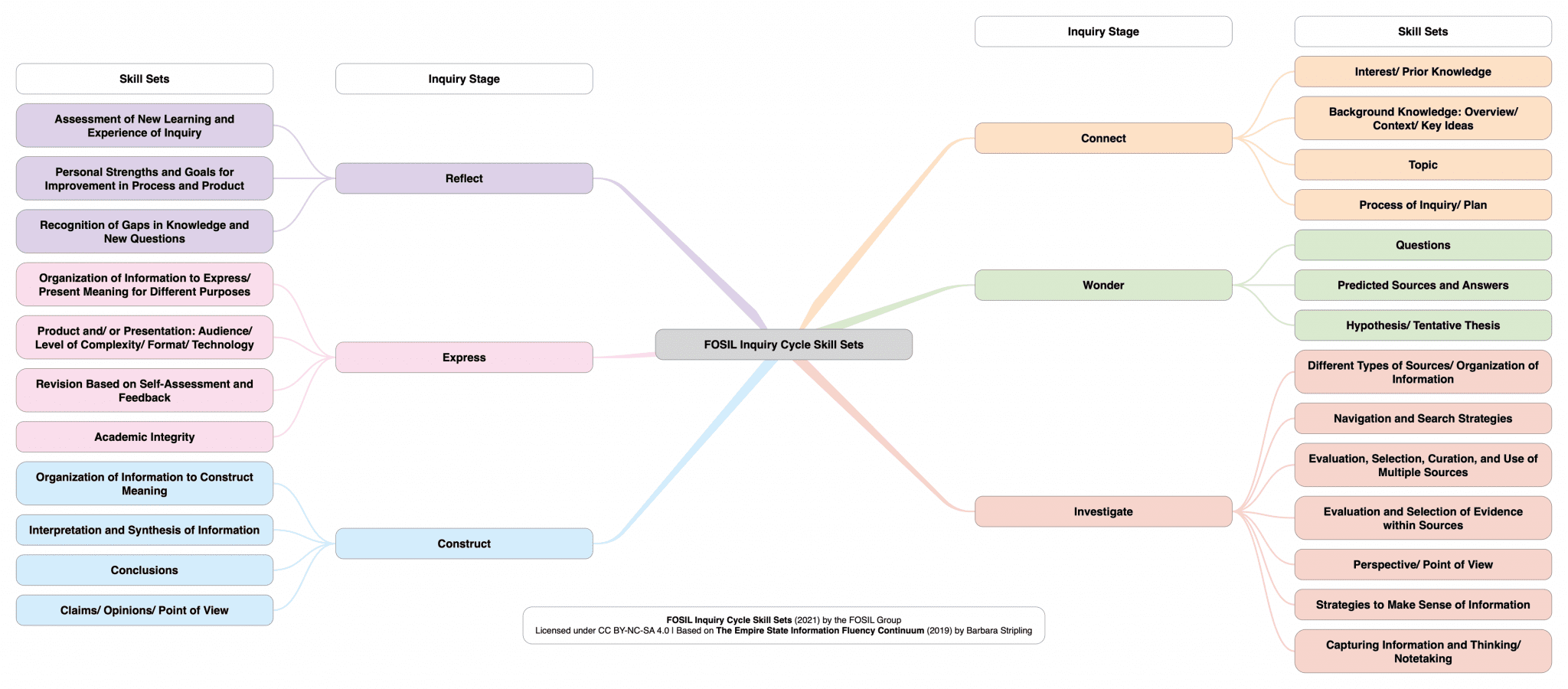
These make it clear that inquiry, as a learning process, is not limited to research, or information literacy–in fact, my work on FOSIL started with wondering what came before and after citing and referencing (see An Extraordinary Journey: FOSIL). They also make it easier for classroom colleagues to locate aspects of what they are doing in the inquiry process, even if they are not [yet] enabling a full inquiry, which facilitates conversation about how to collaborate on inquiry-based learning, whether in part or whole.
—
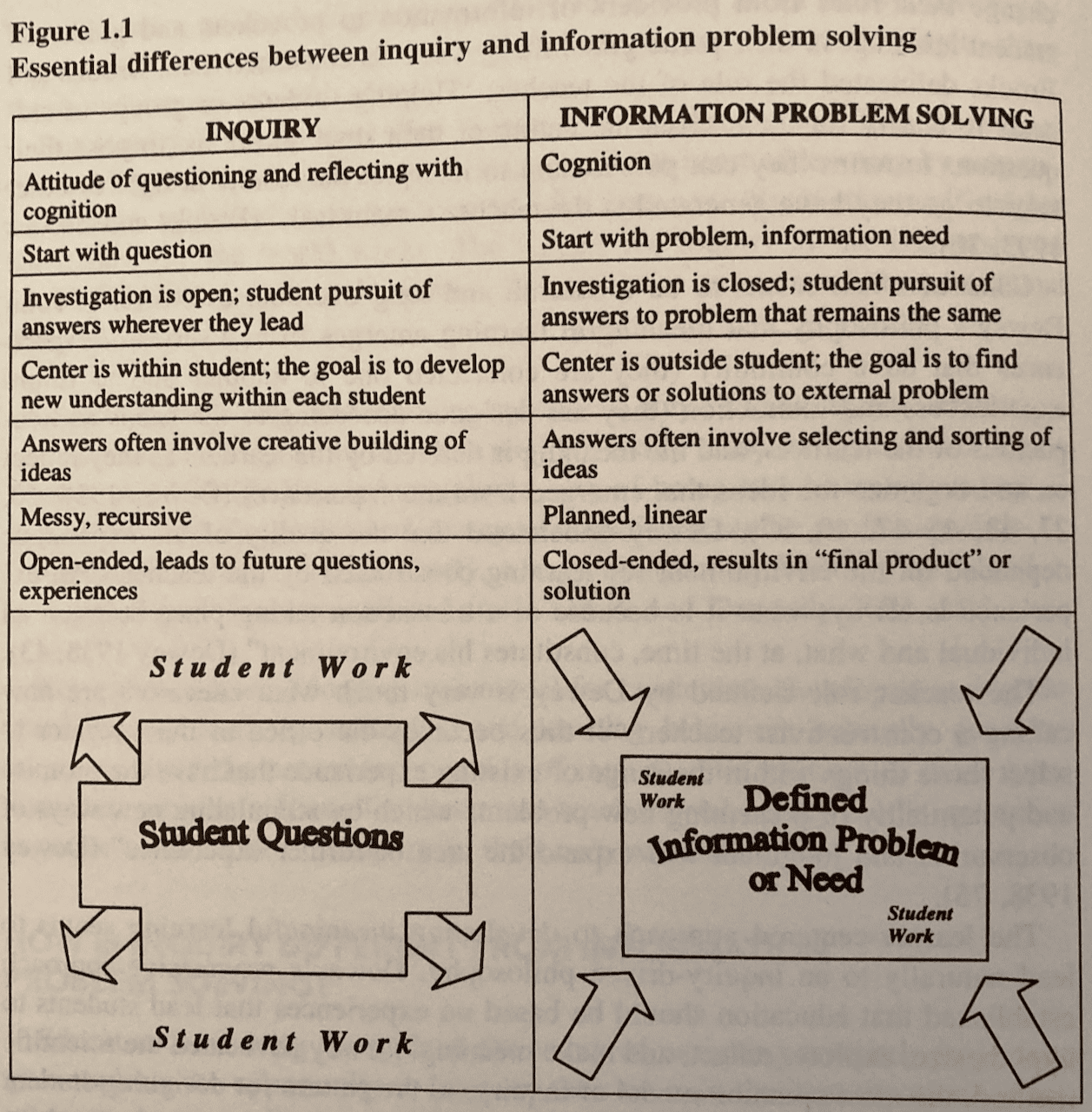
For interest, Barb included a helpful discussion of how inquiry differs from information problem solving, or the research process, in her chapter on inquiry-based learning for Curriculum connections through the library (2003), which also introduced her model of the inquiry process. Note that the starting question in inquiry is not necessarily the same as the final question that emerges from investigate and construct.