Defining “Research” and “Advanced” and “Inquiry”
Home › Forums › The nature of inquiry and information literacy › Defining “Research” and “Advanced” and “Inquiry”
- This topic has 4 replies, 3 voices, and was last updated 2 months, 4 weeks ago by
 Alyssa Bruecken.

-
AuthorPosts
-
29th June 2026 at 9:17 pm #90984
Hello!
I appreciate the breakdown of the actual definition of inquiry in Stripling and Toerien’s book “Teaching Inquiry as a Conversation”. I am finding in my district that we are often equating “research” with the investigate portion of FOSIL rather than the inquiry work. Does anyone have any suggestions for supporting the shift from… oh we will reach out when we do “Research” to how can we look at this unit as a whole immersive inquiry experience?
Thank you!
30th June 2026 at 1:01 pm #91010This question reminded me of a podcast that Darryl and I did a little while ago… Are you teaching research skills or Inquiry?
Hopefully, it might help you understand and think about this a little more. Happy to answer more questions once you have listened if that helps 🙂
30th June 2026 at 4:19 pm #91034Hello, and thank you, Alyssa—and Elizabeth.
Jenny and I are in the final week of our academic year, so will only be able to reply more fully here and elsewhere next week.
However, some immediate thoughts here…
It was/ is necessary, and therefore helpful, to make a distinction between inquiry and research (and information literacy for that matter), which many colleagues, including librarians, conflate, and which is one of the tendencies that saps inquiry of its potency.
Ideal libraries: A guide for schools (2018/2022, p. 9)—citing Callison (2015) and Levitov (2016)—made the point clearly that “inquiry is more expansive than research, and facilitating it requires expertise beyond research methods.”
By then, the shift in school libraries from research process models to inquiry process models had been underway for more than a decade, with Barbara’s model of the inquiry process, which was one of the earliest, being published in 2003. For reasons that I do not fully understand yet, explorations of inquiry as “a method of instruction and an environment for formalized learning” (Shera, 1972, p. 177) had been underway outside of school libraries for far longer. Two examples that I am familiar with are:
- The Developing Inquiring Communities in Education Project (DICEP), which started in 1991 as a collaboration between teachers in public schools (Grades 1–8) in metro Toronto and surrounding areas and university teacher educators at the Ontario Institute for Studies in Education (OISE) of the University of Toronto. However, over its 10 years, the Project saw a shift in focus from “a study of ‘Learning through Talk’ in elementary science classrooms [to] creating opportunities for inquiry-based learning and teaching at all levels and in all areas of the curriculum” (p. 2).
- Even earlier, Neil Postman and Charles Weingartner devoted a chapter to The Inquiry Method in Teaching as a subversive activity (1969), and even then they noted that “of all the ‘survival strategies’ education has to offer, none is more potent or in greater need of explication than the ‘inquiry environment’” (p. 36, emphasis added).
In 2017, Barbara wrote that “the teaching of inquiry skills [within a learning process aimed the acquisition of disciplinary knowledge and understanding] represents a paradigm shift for school librarians [and classroom teachers]” (2017, p. 53), and this paradigm shift is still, frustratingly, underway, as is the need for explication.
I’ll share more on this important topic in due course.
—
References
- Callison, D. (2015). The evolution of inquiry: controlled, guided, modeled, and free. Libraries Unlimited.
- IBO. (2018). Ideal libraries: A guide for schools. International Baccalaureate Organisation (UK) Ltd.
- Levitov, D. (2016). School libraries, librarians, and inquiry learning. Teacher librarian, 28-35.
- Postman, N., & Weingartner, C. (1969). Teaching as a subversive activity. Delacorte Press.
- Shera, J. (1972). Foundations of education for librarianship. Wiley-Becker and Hayes.
- Stripling, B. K. (2003). Inquiry-based learning. In B. K. Stripling & S. Hughes-Hassell (Eds.), Curriculum connections through the library (pp. 3–39). Libraries Unlimited.
- Stripling, B. K. (2017). Empowering students to inquire in a digital environment. In S. W. Alman (Ed.), School librarianship: past, present, and future (pp. 51–63). Rowman & Littlefield.
- Wells, G. (2001). The case for dialogic inquiry. In G. Wells (Ed.), Action, talk & text: Learning and teaching through inquiry (pp. 171–194). Teachers College Press.
7th July 2026 at 11:34 am #91173Continued from post above…
The reason why it is necessary to make a clear distinction between inquiry and research–and, more narrowly, information literacy–is precisely because inquiry is a process through which we learn important disciplinary/ subject content. This process includes research and information literacy–mainly in, but not limited to, Investigate and Express–but is not reducible to research or information literacy. This means that when we are talking with our classroom-based colleagues about inquiry, we are talking with them about acquiring disciplinary/ subject content knowledge, which is their primary concern. Whereas, when we are talking with our classroom-based colleagues about research, or information literacy (or media and information/ digital/ AI/ … literacy), we are talking about part of the process of acquiring disciplinary/ subject content knowledge, and one that, moreover, competes for precious curriculum time for the acquisition of disciplinary/ subject content knowledge, which, most likely, is focussed on the memorisation of information for reproduction in tests. It is a question, then, of trying to convince our classroom-based colleagues of approaching the acquisition of disciplinary/ subject content knowledge through inquiry, or of trying to convince them give up precious curriculum time for something that only partly addresses the acquisition of disciplinary/ subject content knowledge. This may seem like a minor distinction, but, in reality, it makes the world of difference to collaboration between the library and the classroom.
In discussing inquiry as a preferable way to approach the acquisition of disciplinary/ subject content knowledge–one that goes beyond memorisation and reproduction in tests, and is more expansive than research and information literacy–we have found the inquiry process skill sets especially helpful, which were introduced in the 2019 re-imagining of the ESIFC continuum of skills.
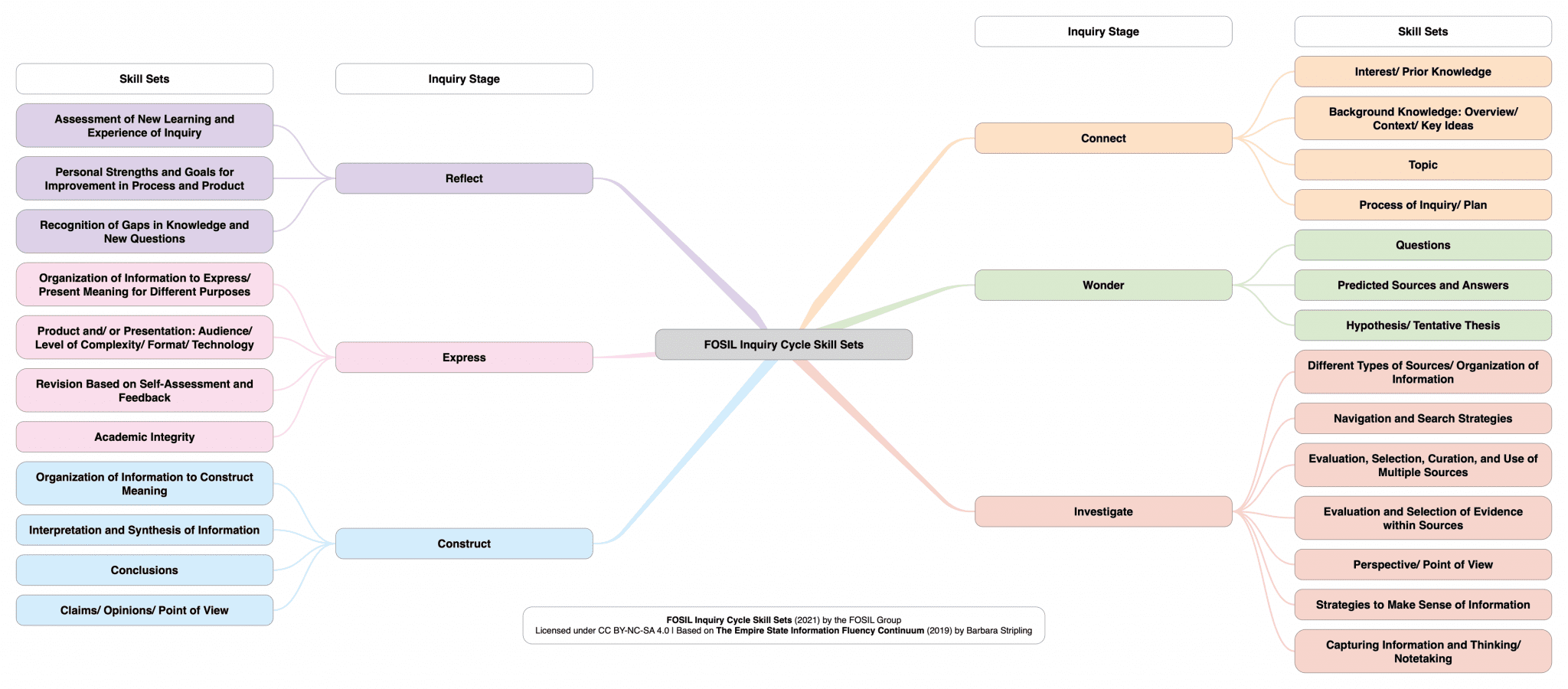
These make it clear that inquiry, as a learning process, is not limited to research, or information literacy–in fact, my work on FOSIL started with wondering what came before and after citing and referencing (see An Extraordinary Journey: FOSIL). They also make it easier for classroom colleagues to locate aspects of what they are doing in the inquiry process, even if they are not [yet] enabling a full inquiry, which facilitates conversation about how to collaborate on inquiry-based learning, whether in part or whole.
—
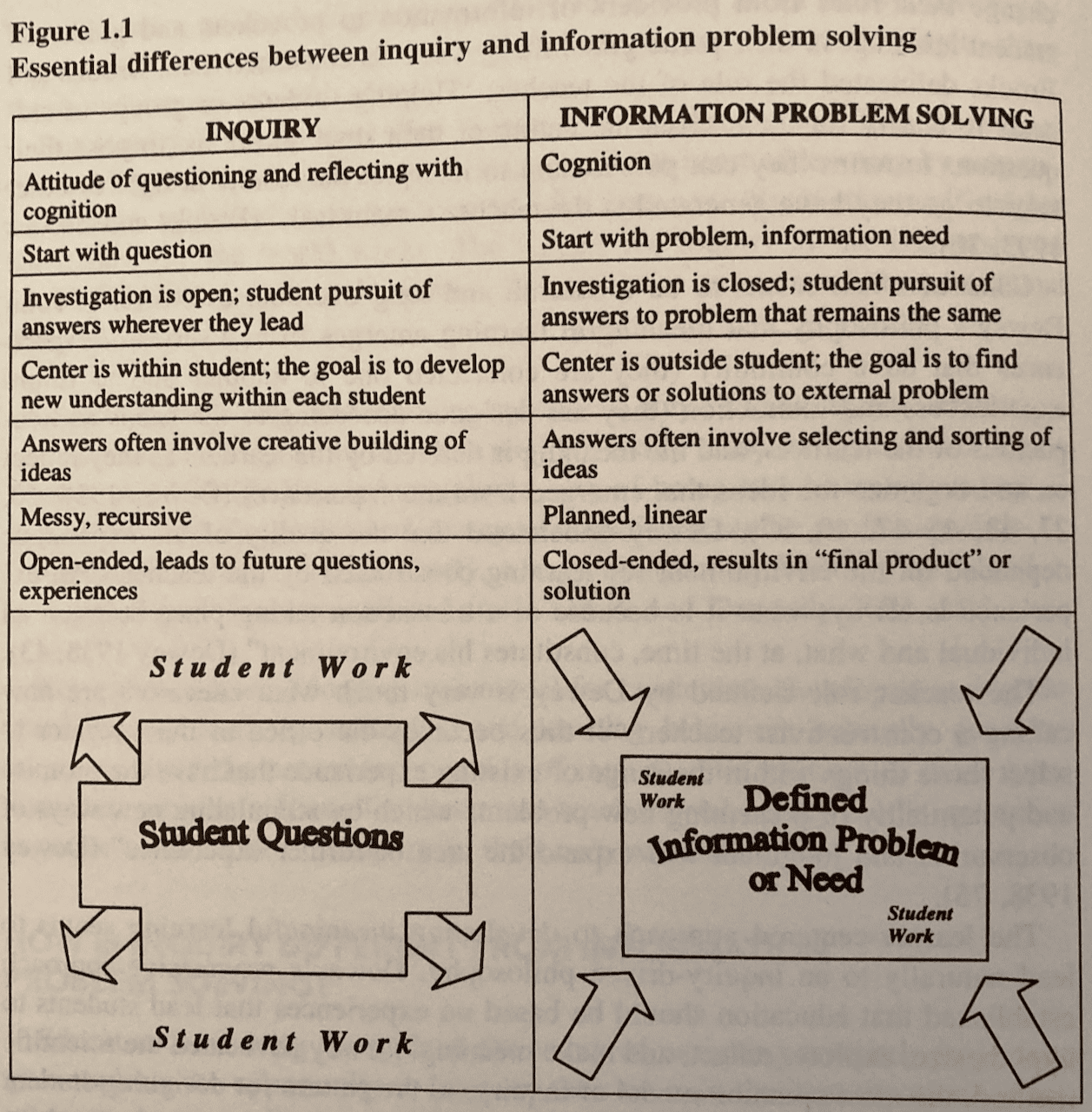
For interest, Barb included a helpful discussion of how inquiry differs from information problem solving, or the research process, in her chapter on inquiry-based learning for Curriculum connections through the library (2003), which also introduced her model of the inquiry process. Note that the starting question in inquiry is not necessarily the same as the final question that emerges from investigate and construct.
 15th July 2026 at 3:57 am #91331
Ah! Postman and Weingartner! I have not read that book since my early teaching years and it was. so. formative – combined with with Universal Design for Learning (Rose and Gordon) it is often hard for me to recalibrate that what happens in the classroom can sometimes be so disconnected from the humans in the classroom (especially at the high school level) that we forget what we are even doing all together in this school. Thank you for sharing this layout from Barb. It is very helpful in the looking at reshaping our units.
One question I thought of posing this year to help shift from “information problem solving” to “inquiry” in light of the time crunch we are all under – is – “what skills are your students engaging in that are transferrable to any other content area?”
Thank you also for the initial definition from Callison and Levitov.
-
AuthorPosts



- You must be logged in to reply to this topic.