Discussing Education, Libraries and FOSIL With Elizabeth Hutchinson
Home › Forums › The nature of inquiry and information literacy › Discussing Education, Libraries and FOSIL With Elizabeth Hutchinson
- This topic has 27 replies, 2 voices, and was last updated 1 week, 6 days ago by
 Darryl Toerien.
-
AuthorPosts
-
3rd December 2024 at 3:19 pm #85074
Thanks, Elizabeth.
I was delighted that we were joined by Ruth Maloney* for Episode 16 of FOSIL, Education and School Libraries.
*Co-host with Elizabeth of Engaging and Empowering School Libraries.
 25th January 2025 at 12:35 pm #85316
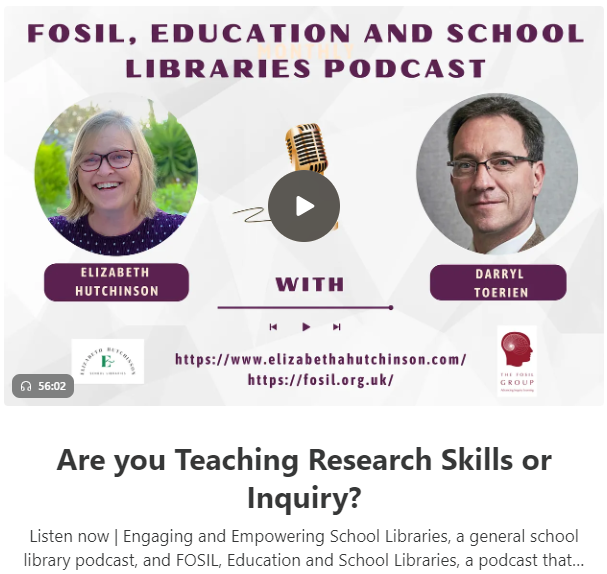
On Wednesday evening of 22 January, Elizabeth and I met for Episode 17 – links to podcast and YouTube video – of our monthly FOSIL, Education and School Libraries podcast series. In this episode we provided some contextual information about the colleagues who will be sharing their valuable insights with us during the FOSIL 2025 Symposium on Saturday 8 February, which is free, online and will be recorded.
The Symposium marks 15 years of thoughtful and purposeful development of FOSIL (2010), and 6 years of the FOSIL Group (2019), which now numbers almost 400 members representing more than 35 countries.
Elizabeth and met in 2011, so she has been a companion on this journey since almost the very beginning.
These are my preparatory notes on colleagues in order of appearance, with Elizabeth introducing Ruth Maloney and Jannath Khanom, who she has a closer working relationship with. Both Ruth and Jannath have made deeply thoughtful contributions to the FOSIL Group Forums.
—
I met Dianne and Jennifer at the IASL 2019 Conference in Dubrovnik, where I had been asked to deliver a keynote presentation – Between the Classroom and the Library (notice a recurring theme!) – following the IFLA 2019 World Library and Information Congress in Athens.
Dianne and Jennifer had been instrumental in developing the deeply thoughtful Alberta Inquiry Model as part of Focus on Inquiry: A Teacher’s Guide to Implementing Inquiry-based Learning. You and I hosted an extended discussion of this enormously helpful document during October, November and December of 2019, which culminated in an online Q&A with Dianne and Jennifer in January of 2020 – see Focus on Inquiry in the FOSIL Group Forum, which includes links to the discussion and webinar. Dianne also authored E&L Memo 2 | Focus on Inquiry: Reflections on Developing a Model of Inquiry for the FOSIL Group Epistemology & Learning Memos series, which I need to revitalise.
Also significant from our perspective is that Dianne was co-editor with Barbara Schultz-Jones of the IFLA School Library Guidelines (2015), followed by Global Action on School Library Guidelines (2015) and Global Action on School Library Education and Training (2019) in the IFLA / De Gruyter Publications series.
Also significant from our perspective, and also in the IFLA / De Gruyter Publications series, is that Dianne was co-editor with Barbara Schultz-Jones of Global Action for School Libraries: Models of Inquiry (2022). Three of the five models included in the book are Stripling’s Model of Inquiry (more on this later), FOSIL and the Alberta Inquiry Model. The book also included a chapter by Joseph Sanders and Jenny Toerien on Deep Collaboration by Teacher and Librarian to Develop an Inquiry Mindset using FOSIL (see also Curricular Inquiry: Learning Between the Library and the Classroom for an online discussion of this work between Joe and Jenny and here for the accompanying PPT presentation).
—
Our relationship with Lee FitzGerald stretches at least as far back as 2021, when we wrote FOSIL: Inquiry As Mind Set, Skill Set, Tool Set and Community for her as Editor of ACCESS (Volume 35, Issue 2, June 2021), the national journal of the Australian School Library Association.
Since then, I have developed a close working relationship with Lee, going on to write six more articles for ACCESS, the last two with Lee: Re/Dis-Covering the Promise of Freedom Through Inquiry – Part 1 (Volume 38, Issue 3, September 2024) and Re/Dis-Covering the Promise of Freedom Through Inquiry – Part 2 (Volume 38, Issue 4, December 2024).
Lee, who is now also Adjunct Lecturer on the Master of Education: Teacher Librarianship course at Charles Sturt University, was previously Head of Service at Loreto Kirribilli in Sydney (Australia), an independent, Catholic school for girls from K-12. Lee oversaw an outstanding inquiry programme. She has remained in contact with Jo, who is the History Coordinator, particularly around the superb Grade 11 Ancient History inquiry. Lee and Jo have enormous experience of Guided Inquiry Design, and Jenny and I worked with them to reframe this inquiry through FOSIL, so I am very excited about that they will be sharing this extraordinary insight into inquiry with us.
—
Blanchelande College in Guernsey (Channel Islands) is an independent, Catholic school for boys and girls from PK-12. While we will not talk about our inquiry programme during the Symposium, we have established Signature Work inquiries in all phases of the College, which are backbone for other inquiry-based work across phases and academic disciplines/ subjects, and reflect on them as often as possible in the FOSIL Group Forum, specifically in Inquiry and resource design.
—
Mary-Rose Grieve | Hartland International School in Dubai (United Arab Emirates) is an independent school for boys and girls from PK-12, which offers a British education “through the National Curriculum for England.” Mary-Rose appears to me, like Elizabeth, to have been a companion on this journey for as long as I can remember. Her perspective is extraordinarily broad, and so particularly insightful. I am deeply envious of her broad and intimate knowledge of books, both non-fiction and fiction, that provoke and foster inquiry, especially for our youngest students.
—
Ruth Maloney | Tonbridge Grammar School in Tonbridge (England, UK) is a “selective grammar school with academy status, educating girls between the ages of 11 and 16 (Grades 6-10) and girls and boys in the Sixth Form (Grades 11-12).”
Ruth’s perspective as a presenter is unique, in that they offer the International Baccalaureate Middle Years Programme in Grades 6-8, the GCSE in Grades 9-10, and the International Baccalaureate Diploma Programme in Grades 11-12. This is the same as Oakham School by the time we left, except that they also offered the A-level alongside the Diploma Programme.
—
Jannath Khanom | Connaught School for Girls in London (England, UK) is a “state funded independent academy” for girls between the ages of 11 and 16 (Grades 6-10).
—
David Harrow, Faye Marland, Nick O’Loughlin | AKS Lytham in Lytham St Annes (England, UK) is an independent school for boys and girls from PK-12. David was Academic Deputy Head at Oakham School and was both a visionary advocate for FOSIL-based inquiry, and inquiry more broadly, and so was instrumental in the establishment of the FOSIL Group as a free and open community of inquiry centred on FOSIL, but not limited to it. Within a year of starting at AKS Lytham, David, Faye and Nick were responsible for enviable celebrations of students as engaged and empowered inquirers across a range of school phases and within a GCE and A-level educational context. The highest compliment that I can pay to David is that, had circumstance been different, Jenny and I would have followed him to AKS Lytham.
—
Barbara Stripling, who [auspiciously, as far as I am concerned] shares a birthday with me, has been a formative influence in my professional development since I first stumbled into school librarianship in 2003.
In that year, Barbara co-edited Curriculum Connections Through the Library, which included a chapter on inquiry-based learning, and introduced me to her model of the inquiry process, and her approach to teaching and learning. This led me to Learning and Libraries in an Information Age (1999!), which Barbara edited, and in which she noted: “A primary emphasis on learning in school libraries represents a paradigm shift for our field, one that is not yet universally understood or effectively implemented. School [librarians] must step forward as instructional leaders in their schools to design library … programs that help students learn important ideas in the curriculum and learn how to learn in the information age.” This identifies an abiding concern with a paradigm shift that we have not yet fully made, and what brings us together for the Symposium.
Barbara also authored E&L Memo 1 | Learning to know and understand through inquiry for the FOSIL Group Epistemology & Learning Memos series, which I need to revitalise.
In view of this, I am both humbled and honoured to be co-authoring Teaching Inquiry as Conversation: Bringing Wonder to Life with Barbara, also for Bloomsbury Libraries Unlimited and in collaboration with Jessica Gribble, Senior Acquisitions Editor.
21st March 2026 at 12:44 pm #89619I can’t believe that it has been over a year since I updated this, but so much has happened since then, which is partly why…
To update, starting with the post above:
The inaugural FOSIL Symposium on Saturday 8 February 2025 — hosted online by Elizabeth, and in-person by Blanchelande College Library — was an extraordinarily uplifting experience, with more than 200 colleagues from around the world joining speakers from around the world for a day-long celebration of enabling our students to develop as engaged and empowered inquirers.
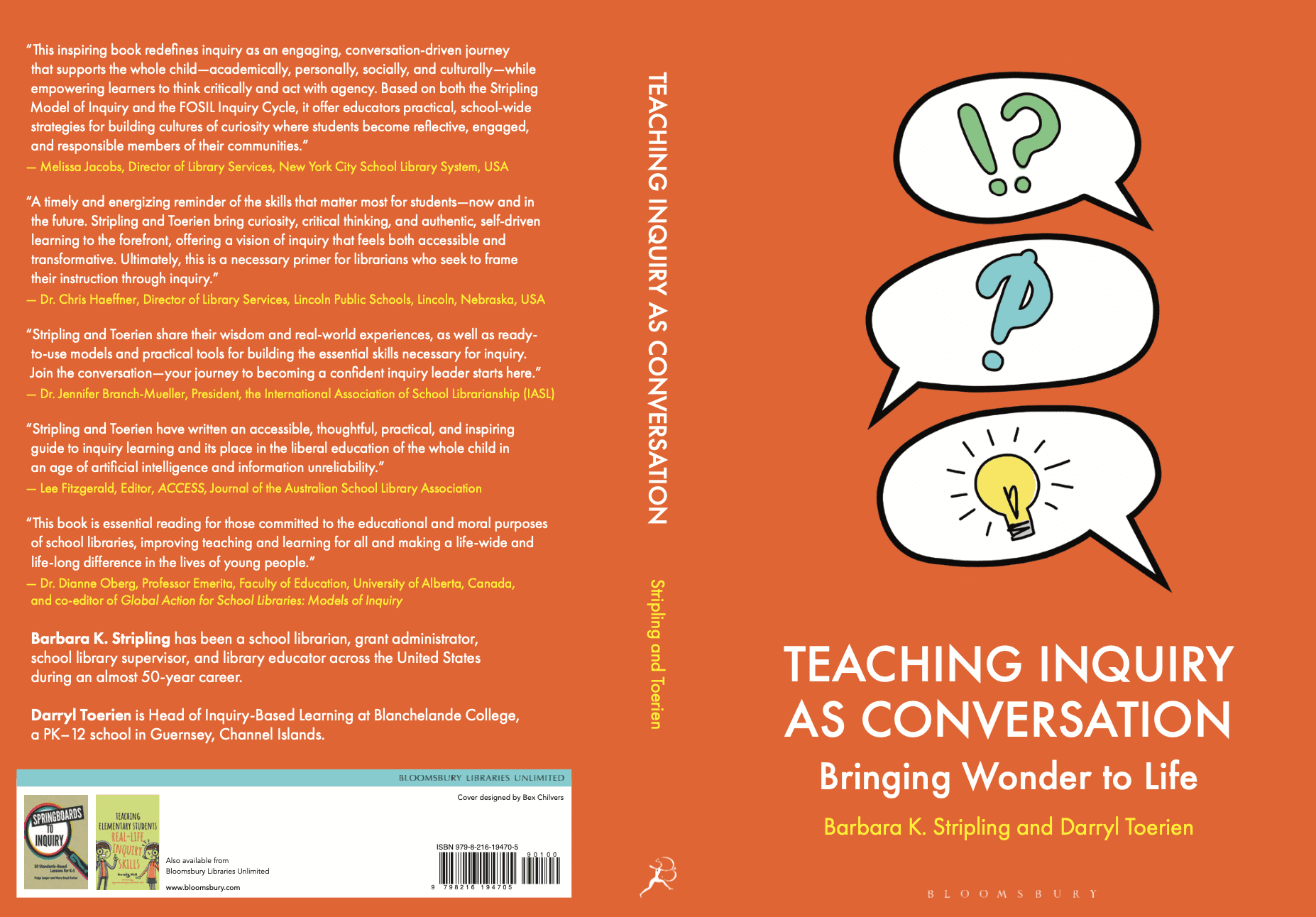
Teaching Inquiry as Conversation: Bringing Wonder to Life, co-authored with Barbara for Bloomsbury, is due to published on 14 May (online) and 11 June (print).
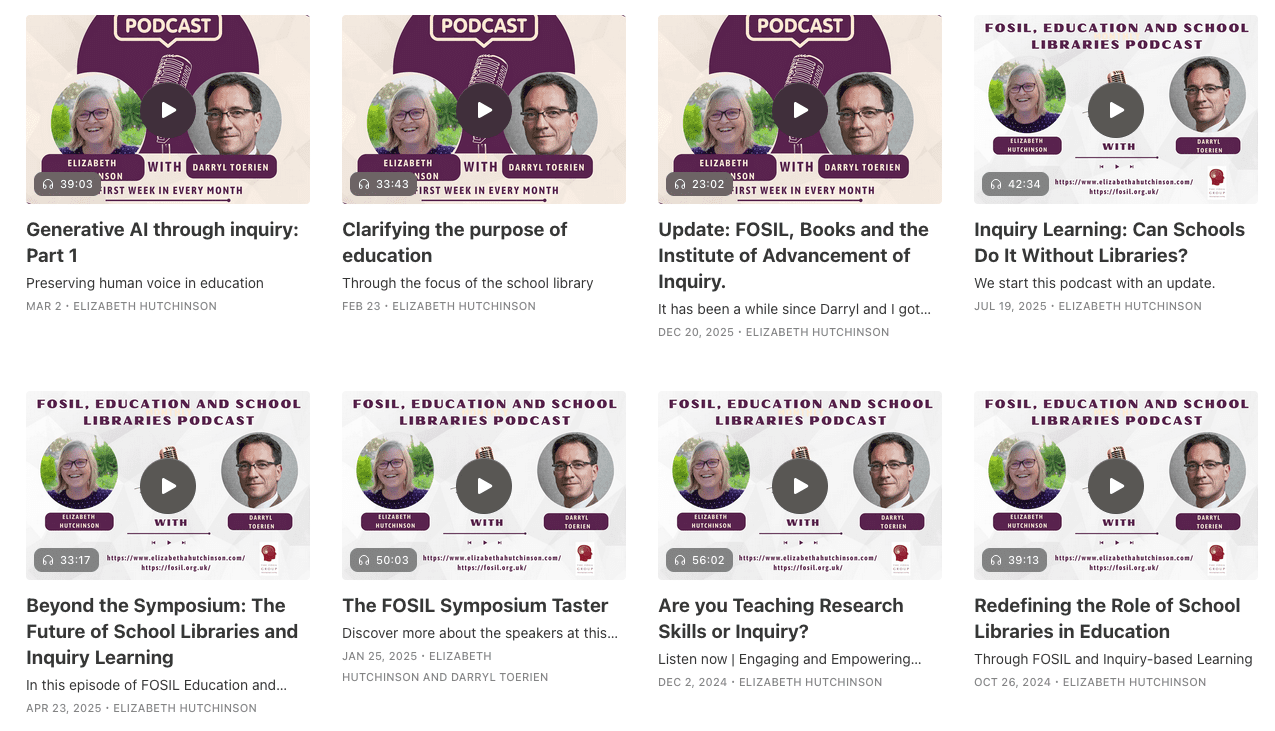
Since Episode 17 of FOSIL, Education and School Libraries — The FOSIL Symposium Taster — we have recorded:
- Episode 18 | Beyond the Symposium: The Future of School Libraries and Inquiry Learning (April 2025)
- Episode 19 | Inquiry Learning: Can Schools Do It Without Libraries? (July 2025)
- Episode 20 | Update: FOSIL, Books and the Institute of Advancement of Inquiry (December 2025)
- Episode 21 | Clarifying the purpose of education through the focus of the school library (February 2026)
- Episode 22 | Generative AI through inquiry: Part 1: Preserving human voice in education (March 2026)
I met with Elizabeth this morning (Saturday 21 March) for Part 2 of Generative AI through inquiry, and will add that here as soon as it becomes available.
 30th March 2026 at 9:26 am #89745
Episode 23 of FOSIL, Education and School Libraries is now available: Generative AI Through Inquiry: Part 2: The place and role of AI in Inquiry.
In this Episode, we discussed GenAI in relation to the Connect stage of the FOSIL Inquiry Cycle, and will do so in relation to Investigate and Construct in the next Episode.
—
 20th April 2026 at 3:00 pm #90114
Episode 24 of FOSIL, Education and School Libraries is now available: Generative AI Through Inquiry: Part 3.
In this Episode, we discussed GenAI in relation to the Investigate and Construct stages of the FOSIL Inquiry Cycle, and will do so in relation to all six stages in the next Episode.
10th May 2026 at 11:33 am #90257Saturday 9 May | Episode 25 of FOSIL, Education and School Libraries is now available: Generative AI Through Inquiry: Part 4.
In this Episode, we discussed GenAI in relation to the Connect and Wonder stages of the FOSIL Inquiry Cycle.
The next Episode, which is scheduled for Saturday 30 May, will be our 26th Episode and mark three years (!) of discussing Education, Libraries and FOSIL with Elizabeth.
References in relation to the Connect and Wonder stages:
- Connect: The sense of awe—in Connect—that moves us to (w/W)onder is reflected in Paul Atreides’ observation in Frank Herbert’s Children of Dune (1976) that we are surrounded by the unknown, which is where we look for knowledge. The movement from the known into the unknown is guided and sustained by significant questions.
- Wonder: Hans-Georg Gadamer (Truth and method, 1960/1994): “To question means to lay open, to place in the open. Only a person who has questions can have knowledge.“
- Wonder: Jerome Bruner (The process of education, 1960/1977): “Given particular subject matter or a particular concept, it is easy to ask trivial questions. … It is also easy to ask impossibly difficult questions. The trick is to find the medium questions that can be answered and that take you somewhere.“
—
 1st June 2026 at 12:59 pm #90582
Episode 26 of FOSIL, Education and School Libraries (recorded on 30 May 2026) is now available: Why does it matter? How do we, as School Librarians, answer this question?.
—
Preparatory notes
This episode marks 3 years of an ongoing conversation with Elizabeth in this format, and 15 years since we first met. A central theme of our ongoing conversation has been,
What kind of school library/ian is integral to what kind of educational process?
How we answer this question matters — why?
All schools are public schools, in that they produce a public. The question, then (Postman, 1996), “is not, Does or doesn’t public schooling create a public? The question is, What kind of public does it create? A conglomerate of self-indulgent consumers? Angry, soulless, directionless masses? Indifferent, confused citizens? Or a public imbued with confidence, a sense of purpose, a respect for learning, and tolerance?”
This is why the chief task of education is to guide the evolving dynamism through which a person forms themself as a person (Maritain, 1943). However, in order to make sense of this, we need some understanding of what this evolving dynamism is, as well as the process through which a person forms themself as a person.
The “ultimate freedom we have as human beings is the power to select what we will allow or require our minds to dwell upon” (Willard, 2002). Now, what we will allow or require our minds to dwell upon, is who we are, or are in the process of becoming. This fact is empowering, in that we can determine who we are in the process of becoming by what we choose to think about, or dwell on mentally. This fact is also sobering, in that we must do so, whether consciously or not. This brings the importance and value of our chief task as educators into sharp focus, especially in relation to the mind and the thoughts it thinks.
Willard (2002) continues that “the realm of thought involves four main factors. These are ideas, images, information, and our ability to think, but the two most powerful ones are ideas and images.” More on this next time…
Links/ quotations/ updates:
- Keynote for the UK School Library Association 2021 Conference | Inquiry: An Educational and Moral Imperative (includes links to the IFLA School Library Guidelines and the IFLA/UNESCO School Library Manifesto).
- An article for ACCESS (37:4) | Constructing an Instructional Identity and Destiny From the Stories We Tell and the Songs We Sing.
- Matt Seybold‘s (2026) The American Vandal podcast. “The durability of a totalitarian state depends upon systemic assaults on mass literacy followed by continuous suppression of conditions for its reemergence.”
- FOSIL Group Forum post with links to infographics for Pope Leo XIV‘s (2026) Magnifica Humanitas (Magnificent Humanity): On safeguarding the human person in the time of artificial intelligence. | Tolkien/ Gandalf quotation: “It is not our part to master all the tides of the world, but to do what is in us for the succour of those years wherein we are set, uprooting the evil in the fields that we know, so that those who live after may have clean earth to till.”
- An article for The School Librarian (74:2) | Inquiry: Fundamentally Creative and Fundamental to Creativity.
- SJSU 2026 | ALiVE Library | Teaching Inquiry as Conversation with Barbara Stripling and David Loertscher now includes a link to the recording. Details of the book may be found here.
6th July 2026 at 10:22 am #91172Episode 27 of FOSIL, Education and School Libraries (recorded on Saturday 4 July 2026) is now available: Four Domains of Thought (Part 1): Ideas and Images.
—
Preparatory notes
Robert A. Heinlein: “Dad claims that library science is the foundation of all sciences just as math is the key–and that we will survive or founder, depending on how well the librarians’s do their jobs.”*
Douglas Knight: The two major and unique functions of a library of any type are that it is a space for the encounter between the minds of our students and ideas [in our collections, especially non-fiction], and the extension of those ideas in the minds of our students.
Dallas Willard: “The realm of thought involves four main factors. These are ideas, images, information, and our ability to think, but the two most powerful ones are ideas and images.”
- “Ideas are very general models of our assumptions about reality. They are ways of thinking about and interpreting things.” E.g., love and leadership.
- “Closely associated with governing ideas are the images that occupy our minds. Images are always concrete or specific, as opposed to the abstractness of ideas, and are heavily laden with feeling. They frequently present themselves with the force of perception and have a powerful emotional linkage to governing idea systems. They mediate the power of those idea systems into the real situations of ordinary life.” E.g. [from revision with my son for his end-of-year Theology exam], love (Cupid, or Jesus on the cross), and leadership (Napoleon Crossing the Alps by Jacques-Louis David, or Christ Washing the Disciples’ Feet by Tintoretto)
- “Without correct information (or facts), our ability to think has nothing to work on. … Lack of information results in everything from unpleasant burdens to stark tragedies.”
- Thinking “is the activity of searching out what must be true, or cannot be true, in the light of given facts or assumptions. It extends the information we have and enables us to see the ‘larger picture’–to see it clearly and to see it wholly. And it undermines false or misleading ideas and images as well. It reveals their falseness to those who wish to know.”
- “Prospering depends upon people thinking well.”
- “Bluntly…crooked thinking, unintentional or not, always favors evil. And when the crooked thinking gets elevated into group orthodoxy, whether religious or secular, there is always, quite literally, ‘hell to pay.’ That is, hell will take its portion, as it has repeatedly done in the horrors of world history.”
- “By ‘thoughts‘ we mean all of the ways we are conscious of things. That includes our memories, perceptions, and beliefs.”
References
- Robert A. Heinlein, Have space suit–Will travel (1975/78, p. 128).
- Douglas Knight (1921–2005), Then-President of Duke University and Chairman of the United States National Advisory Commission on Libraries. See ‘Foreword’ to Library services for the nation’s needs: Toward fulfillment of a national policy (1968), by the United States National Advisory Commission on Libraries.
- Jacques Maritain (1882–1973), French philosopher and political thinker (Stanford Encyclopedia of Philosophy). See Education at the crossroads (1943/60, Yale University Press) and The education of man (1962/67, Notre Dame University Press).
- Dallas Willard (1935–2013), Professor Emeritus in Philosophy at the University of Southern California, Los Angeles. See The unhinging of the American mind–Derrida as pretext (1999) and Ontology of knowledge course (1997). For quotations, see ‘Transforming the mind’ in Renovation of the heart (2002, NavPress).
13th July 2026 at 9:45 am #91287Episode 28 of FOSIL, Education and School Libraries (recorded on Saturday 4 July 2026) is now available: Four Domains of Thought (Part 2): Information and the Ability to Think.
3rd August 2026 at 10:45 am #91622Episode 29 of FOSIL, Education and School Libraries (recorded on Sunday 2 August 2026) is now available: Inquiry as Conversation: FOSIL, School Libraries and the Future of Learning.
Barbara Stripling joined us for this special episode, and I asked her the following question to get us going:
- Inquiry as conversation
- There was a shift from a resource-centred view of the library in 1970s to a student-centred view in the 1980s
- Brainstorms and blueprints: Teaching library research as a thinking process (1988) was the result of a conversation between you and your colleague and friend, Judy Pitts
- Curriculum connections through the library (2003) marked the shift from a research process to an inquiry process for you, in which you introduced your model of the inquiry process
- Your model then became integral to the New York City Information Fluency Continuum (NYCIFC, 2009)
- The NYCIFC was then endorsed by New York State and became the Empire State Information Fluency Continuum (ESIFC, 2012)
- The ESIFC was then re-imagined (2019)
- Now, the re-imagined ESIFC is scheduled to be re-imagined again (2026/7)
- Why is this conversation, which stared more than 50 years ago for you, still worth having?
Priorities for me going forward are:
- Paulo Freire’s notion that inquiry–coming to know and understand reality–is a dynamic interplay between reading the world [through experience] and the word [through the record of experience, both our own and those of others].
- Something vitally important happens between making sense of information about the world–Investigate–and finding meaning in that information–Construct–which is worthy of greater attention.
- Dallas Willard’s four main factors involved in the realm of thought–ideas, images, information and thinking–will be helpful, here, both in terms of designing and supporting inquiry, but also clarifying the role of the library/ian in this.
- Barb and I devoted quite some time to discussion the role of deep reading in the inquiry process, and there is scope for doing so for writing, especially in terms of writing to make sense of and find meaning in.
- More broadly, then, to make a case for a liberal education with inquiry as distinguishing feature.
25th August 2026 at 10:06 am #92083Episode 30 of FOSIL, Education and School Libraries (recorded on Saturday 22 August 2026) is now available: What Happens When We Let Students Wonder?.
Gabrielle Mace, joined us for this special episode.
Gabrielle is a literacy consultant, former Head of Library Services and Teacher Librarian, whose work focuses on reading culture, inquiry and the role of school libraries in developing engaged, thoughtful readers and learners. She has worked with inquiry throughout her career and is currently exploring the intersection between deep reading, inquiry and student engagement in her practice.
—
Elizabeth’s blurb
In this episode, we’re joined by Gabrielle Mace to explore the connections between deep reading, inquiry and the school library. We discuss Gabrielle’s work developing immersive inquiry experiences, the ideas in Teaching Inquiry as a Conversation, and what it means to create a culture of inquiry in schools. Along the way, we explore curiosity, conversation, student agency and the important role school librarians can play in helping students become thoughtful, independent learners.
Links
The Student Detective — Gabrielle’s structured inquiry experience that transforms the way students read, think and collaborate.
Teaching Inquiry as a Conversation: Bringing Wonder to Life by Darryl Toerien and Barbara Stripling.
5th September 2026 at 11:52 am #92295Episode 31 of FOSIL, Education and School Libraries (recorded on Saturday 29 August 2026) is now available: Inquiry as Conversation: Who Does the Thinking?.
We were again joined by Gabrielle Mace for this special episode.
Gabrielle is a literacy consultant, former Head of Library Services and Teacher Librarian, whose work focuses on reading culture, inquiry and the role of school libraries in developing engaged, thoughtful readers and learners. She has worked with inquiry throughout her career and is currently exploring the intersection between deep reading, inquiry and student engagement in her practice.
Gabrielle’s questions that we explored answers to in this Episode:
1. Inquiry as conversation | A central proposition of Inquiry as Conversation is that inquiry is fundamentally conversational: with ideas, information, other people and ourselves. | What becomes possible when we understand inquiry in this way, rather than primarily as a process students move through? (Reference: Chapter 2, pp. 15-22)
2. From research process to knowledge construction | When Barbara discusses the development of her model, she describes a shift from a research-driven process model towards an inquiry model grounded in constructivism and social constructivism, where learners actively construct knowledge through their experiences and interactions rather than simply acquire information. | What changes in our teaching when we genuinely understand inquiry as knowledge construction rather than information acquisition? And what does the social dimension of constructivism add to that process? (Reference: Chapter 3, pp. 31-35)
3. Revision, evidence and intellectual humility | One idea in the book that particularly interests me is the changing relationship between the inquirer and what they think they know. In my own inquiry design, I deliberately use new evidence that can destabilise an earlier, perfectly plausible interpretation. Darryl and Barbara discuss ‘adaptability and resilience’ and the dynamic nature of inquiry requires this mindset. | Is the willingness for students to say “I may have been wrong” and to reconstruct understanding when the evidence demands it, an essential disposition of genuine inquiry? (Reference: Chapter 4, p. 49)
4. Where does inquiry reside? | The book has made me think about where the intellectual work of inquiry actually resides. In The Student Detective, I deliberately create a bounded, curated information environment so that students can spend more of their time reading closely, evaluating evidence, making connections, discussing competing interpretations and constructing and revising explanations rather than formal research. | How do you think about the relationship between information-seeking and these other dimensions of inquiry? Are there different ways of designing the information environment depending on the kind of inquiry thinking we are trying to develop?
5. Inquiry in the age of generative AI | The book’s argument feels particularly urgent in an environment where generative AI can provide an immediate, fluent answer and potentially remove much of the productive struggle involved in inquiry. At the same time, AI makes questions of authority, evidence, interpretation and reliability even more important. | Does inquiry as conversation become more important, rather than less, in an AI-rich information environment?
6. Instructional mindset and the gradual release of skills | In the chapter on Teaching the Skills and Attitudes of Inquiry, you and Barbara argue that before we plan instruction, we need to clarify our own instructional mindset – including what we want students to understand, how we teach through conversation rather than delivery, and ultimately how we enable students to become independent learners. You also draw on the Gradual Release of Responsibility, where the cognitive work shifts from teacher-driven, to shared, and ultimately to student-driven. | What does that gradual release look like in genuine inquiry? How do we know when we’re providing the scaffolding students need, and when we’re actually doing too much of the intellectual work for them? (Reference: Chapter 8, pp. 105-106)
—
Note: We didn’t get to the final question, so we will be discussing it in our next episode.
7. Reading as inquiry conversation | Yours and Barbara’s concept of inquiry as conversation has made me think differently about reading. I’ve been observing what happens when students need to read because they genuinely need the information to resolve uncertainty, including voluntarily returning to something they’ve already read because new evidence has changed its possible meaning. | Do you see reading itself as an inquiry conversation, and are reading and inquiry more deeply connected than we sometimes acknowledge in schools?
—
Elizabeth’s blurb
In Part 2 of our conversation with Gabrielle Mace, we continue exploring the ideas behind Teaching Inquiry as Conversation. You can listen to Part 1 here.
This time, we ask a deceptively simple question: who is actually doing the thinking?
We explore what it means for students to construct knowledge rather than simply acquire information; why changing our minds in response to evidence is an important part of inquiry; and what happens when teachers provide so much support that they begin doing the intellectual work for students.
We also consider how generative AI changes the information environment, and why the role of the school librarian in developing increasingly independent inquirers may matter more than ever.
And, as usual, the conversation leaves us with more questions than answers.
Links
The Student Detective — Gabrielle’s structured inquiry experience that transforms the way students read, think and collaborate.
Teaching Inquiry as a Conversation: Bringing Wonder to Life (2026) by Darryl Toerien and Barbara Stripling.
25th September 2026 at 5:15 pm #92729Episode 32 of FOSIL, Education and School Libraries (recorded on Saturday 19 August 2026) is now available: Reading Is Inquiry: Helping Students Make Sense of Their World.
We were again joined by Gabrielle Mace for this special and final episode in this series.
Gabrielle is a literacy consultant, former Head of Library Services and Teacher Librarian, whose work focuses on reading culture, inquiry and the role of school libraries in developing engaged, thoughtful readers and learners. She has worked with inquiry throughout her career and is currently exploring the intersection between deep reading, inquiry and student engagement in her practice.
—
Gabrielle’s question that we explored answers to in this episode was:
7. Reading as inquiry conversation | Yours and Barbara’s concept of inquiry as conversation has made me think differently about reading. I’ve been observing what happens when students need to read because they genuinely need the information to resolve uncertainty, including voluntarily returning to something they’ve already read because new evidence has changed its possible meaning. | Do you see reading itself as an inquiry conversation, and are reading and inquiry more deeply connected than we sometimes acknowledge in schools?
—
My preparatory notes follow below.
Yes.
Revisit Jacques Maritain from previous Episode
“Nothing is more important than the events which occur within that invisible universe which is the mind of [a person]. And the light of that universe is knowledge. If we are concerned with the future of civilization we must be concerned primarily with a genuine understanding of what knowledge is, its value, its degrees, and how it can foster the inner unity of the human being.”
Not just information—”inert ideas”, as Whitehead (1929) puts it—so what is knowledge and how do we get it? Again Whitehead—the joy of discovering that ideas can help students make sense of the stream of events that pours into their lives, is their lives, which is reality.
Paulo Freire: Paulo Freire’s The importance of the act of reading (1983), in which he observes that
“reading the world precedes reading the word, and the subsequent reading of the word cannot dispense with continually reading the world” (p. 5).
Now, as Norman Beswick (1967) noted
“some knowledge [of the world/ reality], truly, comes from experience and experiment [reading the world]; most knowledge from record [reading the word], in the widest McLuhan-like sense” (p. 201).
This is vitally important, because it broadens our understanding of what it means to read, and, indeed, what can be read. And, in case it is not obvious, this is inquiry—coming to know and understand reality through learning to accurately and dynamically read the world (experience and experiment) and the word (record).
Simone Weil: Developing attention—making yourself fully available—is of utmost importance. Attention cannot be forced, but can be captured by words that are worthy of attention, words that are revelatory.
I have been giving much thought to reading [and writing—still to come] throughout the inquiry process:
- Connect | Reading to engage with the text intellectually and emotionally
- Wonder | Reading to enter into dialogue with the text
- Investigate | Reading to make sense of/ know the text (what is the text saying to me?)
- Construct | Reading to find meaning in/ understand the text (what does the text mean to me?)
- Express | Reading to communicate personal knowledge and understanding
- Reflect | Reading to reflect on learning
Moreover, inquiry is communal/ conversational—elsewhere (1970/2005), Freire writes that
“apart from inquiry, apart from the praxis, individuals cannot be truly human, [because] knowledge emerges only through invention and re-invention, through the restless, impatient, continuing, hopeful inquiry human beings pursue in the world, with the world, and with each other” (p. 72).
Now school, in my experience, does not view inquiry in relation to reading in this way, or at least not coherently and consistently.
-
AuthorPosts

- You must be logged in to reply to this topic.