Making Sense of and Constructing Meaning From Information
Home › Forums › The nature of inquiry and information literacy › Making Sense of and Constructing Meaning From Information
- This topic has 3 replies, 2 voices, and was last updated 3 months, 1 week ago by
 Alyssa Bruecken.

-
AuthorPosts
-
21st January 2025 at 2:48 pm #85315
During the inaugural FOSIL Symposium on Saturday 8 February – which will be free, online and recorded – Hugh Rose and I will share the Creative Commons reboot of the Heroic Inquiry Journey.
The Heroic Inquiry Journey is the stages in the FOSIL-based inquiry process aligned with the iconic stages in the Hero’s / Heroine’s Journey as developed by Hugh at Blanchelande College, which adds instructional depth to both. The purpose of the reboot is to reconceptualise the ‘classical’ iconic stages of the Heroic Inquiry Journey in terms more familiar to a contemporary audience, and so more accessible, which we are eagerly looking forward to sharing.
This is how I described the Heroic Inquiry Journey when working on it with Hugh in 2021:
Genuine inquiry is always a heroic journey – intellectual, certainly, but also, and equally important, physical, emotional and social – from the comfort of the known into the discomfort of the unknown, there to wrestle knowledge from information and understanding from knowledge. There lurks real danger here, for being even somewhat misguided can lead far astray, and so discerning those who would help from those who would hinder, or even harm, is vital. From this now-enlightened place to return, enlivened and alive to possibilities heretofore unimagined. And so to set off again.
This heroic journey of inquiry is the story of those who have stretched the boundaries of human knowledge and understanding in one or more of the fields of study in which they laboured, and those who labour there still. It is this unfolding story that we are inviting our students to identify with and, in learning to stretch the boundaries of their own knowledge and understanding, add their voice to and so find their place in.
While all of the stages are important, in terms of learning from information – acquiring knowledge and understanding of ourselves and each other in the world as the basis for responsible participation in society – especially in an increasingly digital environment, Investigate and Construct take on added significance, and I share the ‘classical’ iconic stages here ahead of my talk during the Symposium.
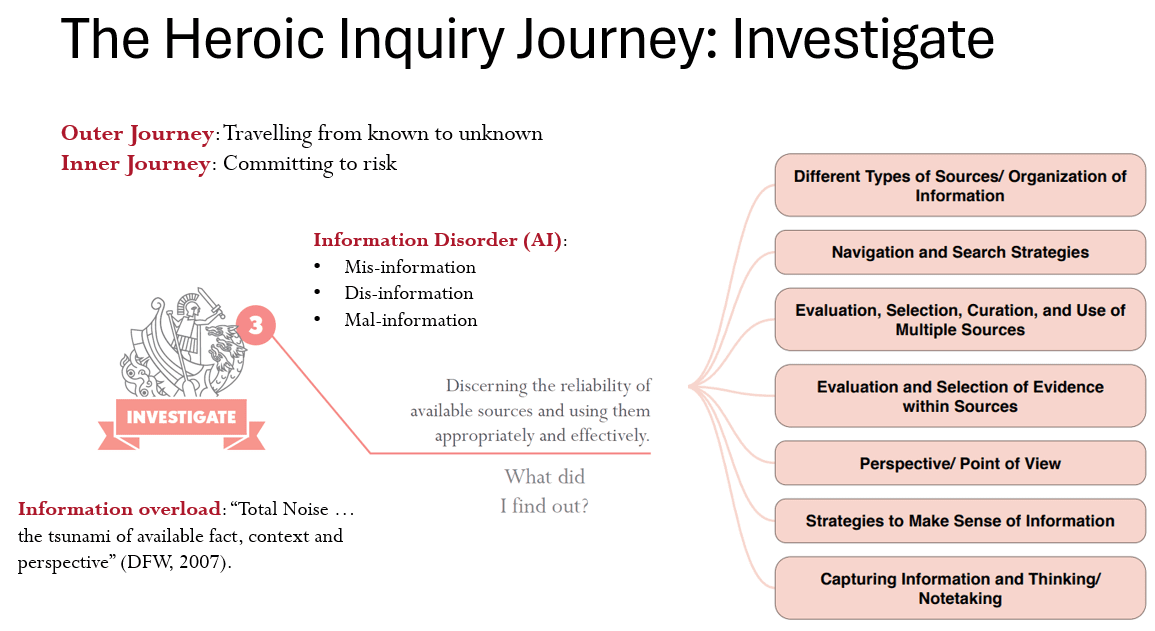
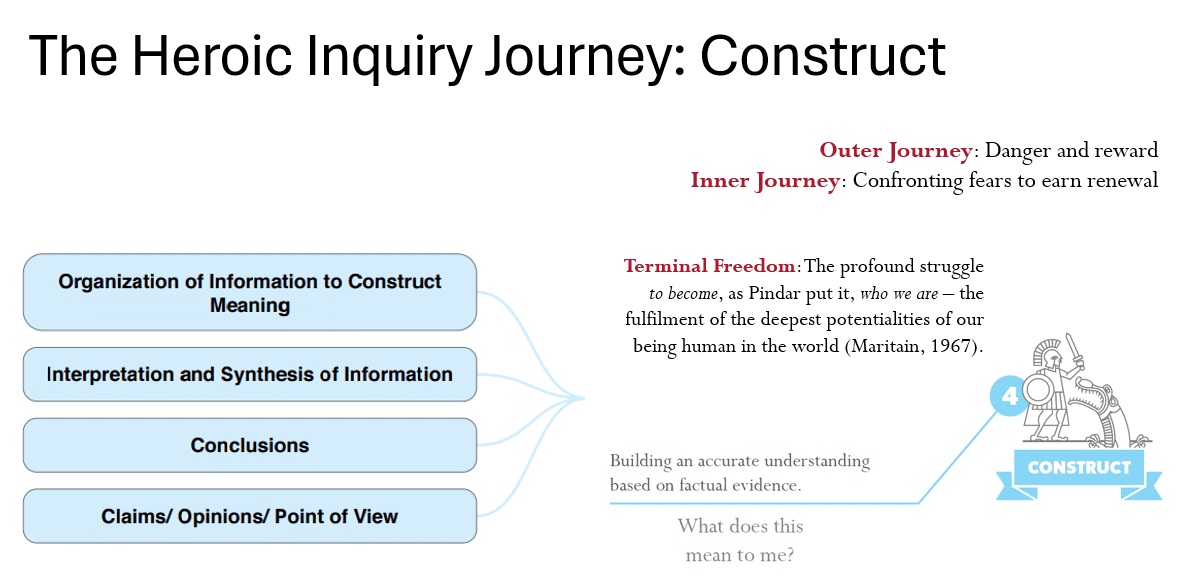
Given that our concern with Heroic Inquiry is actually the emergence of an engaged and empowered Heroic Inquirer, the following observation by Jacques Maritain (The Range of Reason, 1952, p. 3) is worth reflecting on, especially in what appears to be the dawning of a dark age:
Nothing is more important than the events which occur within that invisible universe which is the mind of [a person]. And the light of that universe is knowledge. If we are concerned with the future of civilization we must be concerned primarily with a genuine understanding of what knowledge is, its value, its degrees, and how it can foster the inner unity of the human being.

The Heroic Inquirer stands, feet firmly planted in the scroll that is the unfolding record of human knowledge, upholding and upheld by the light, which illuminates the way ahead.
29th June 2026 at 9:38 pm #90985I’ve been thinking a lot about the connection of the Heroic Journey to the FOSIL inquiry stages and I would like to pose a question that has perhaps already been wrestled with elsewhere (if so, forgive me).
I am wondering if there are any iterations of the stages highlighted here (especially but could be any of the stages) that are recommended to be done in dialogue with other (peers, specifically). One thing I notice about both the heroic journey and how we talk about inquiry in general is that it is typically done in ones own mind. But, in fact, most of wrestling with information is done with others. How do we/can we highlight practices that amplify the idea of “you are not alone in your search..” especially in the face of Artificial Intelligence? How can these stages call us to move intentionally toward each other?
Perhaps this is too big of a question for this forum, but all the elements of this post reminded me of this query I’ve had for awhile. Thank you!
7th July 2026 at 2:03 pm #91174This is an excellent question, Alyssa, and one that I have been wrestling with since I first started working on FOSIL in 2010.
There is a tension here, which Jonathan Rauch (2021, p. 4) describes very well:
[while] acquiring knowledge [necessarily involves] personal struggles to find the right questions and assemble mosaic tiles of information to tell the tale coherently, [acquiring knowledge] is a conversation, not a destination…a journey we take together, not alone, [because] others are always involved [whether living or dead].
I have tended to err on side of personal struggles, mainly because I don’t think students have much space [or time] for the quiet stir of thoughts (John Ciardi), but also because enabling meaningful and productive conversation during an inquiry is challenging.
I am, however, wrestling with this more purposefully at the moment as I begin planning ahead for the next iteration of our Year 9 (Grade 8) Interdisciplinary Signature Work Inquiry @ Blanchelande College, particularly from this post onwards, and in the light of Paulo Freire‘s observation that:
reading the world precedes reading the word, and the subsequent reading of the word cannot dispense with continually reading the world.
I also recommend Action talk, and text: The case for dialogic inquiry (2001), by Gordon Wells (DICEP).
References
- Freire, P. (1983). The importance of the act of reading. Journal of education, 165(1), 5–11. tinyurl.com/38x8etpj.
- Rauch, J. (2021). The constitution of knowledge: A defense of truth. Brookings Institution Press.
15th July 2026 at 4:18 am #91332I’m wondering if a reflection point along the Heroic journey during the investigate and construct phases (in light of the information situation we are in at the moment) might be useful to students. I wonder this because I initially thought students would be turn toward each other during Connect and Wonder. But, in fact, it seems we actually reach out to each other most when we are in the throes of wrestling (metamorphosizing?). And rather than cocoon as a butterfly does – the success of our quest often relies on the connections we have (be it someone to reflect with during the construct phase or access to a particular database during the investigate stage…). Are these days of the journey important for teachers to be aware of how to facilitate students turning toward one another.
Currently reading “Holding Change” by adrienne maree brown and she has some wonderful and simple assessments that break down the health of a room to prepare for facilitation. Additionally, I’m reading “The Sacred Art of Teaching” by Lisa Delpit and Christopher Emdin and just am continually struck by the need for our students to learn how to turn toward each other.
Often, I enter classrooms and students have no idea the names much less inquiry question that the student is wrestling with next to them (we are talking like 3 months into a term and at least 2 weeks into a individual inquiry project). Sometimes my role is connecting one student with another who are working on searching for similar resources. And, since, we are all working against Cognitive Surrender, I’m wondering how intentional dialogue (even if just reflection) with each other on their inquiry process could build connection, empathy, general classroom safety. I’m aware it’s not going to be easy but I do argue… it might be necessary.
Thank you for sharing Gorden Well’s work. I will be annotating that soon – it is absolutely emboldening.
I wanted to ask your role with the inquiry process in your school – is it mostly for the signature work? The closest thing we have my high school is those who participate in an Extended Essay through the IB program. This is an extremely small percentage of our school. My work mostly consists of helping teachers refine their units through the inquiry lens. I REALLY enjoyed seeing your scope and sequence for your high school and post hearing the conversation between you and Hutchinson – I am curious how a focus on annotation will go this year. Similarly, I have set forth with a goal to advocate for note taking and annotating in our classrooms on “research days” as a start. It is a skill and expectation we have somewhat lost. . . conversations with the text and conversations with each other..
I saw this in one of your posts and thought about how it might look if we thought of it through the lens of dialogue. Literacy as communication:
-
<li style=”list-style-type: none;”>
| Reading to engage with the text intellectually and emotionally Dialogue embedded
Wonder| Reading to enter into dialogue with the text Dialoging utilzing Hiliary Janks critical literacy questions (Can post later)
Investigate | Reading to make sense of/ know the text (what is the text saying to me?) Dialoging to make sense
Construct| Reading to find meaning in/ understand the text (what does the text mean to me?) Dialoguing to find meaning
Express| Reading to communicate personal knowledge and understanding Dialogue embedded
Reflect| Reading to reflect on learning dialogue embedded
Truly just reflecting at this point – on the safe spaces I’ve entered – classrooms created for vulnerability and relationship and ones I’ve entered that centered around the “right answer” and “getting it done”. Something is there in the way we encourage students to engage in discourse with each other and the teacher…
-
AuthorPosts


- You must be logged in to reply to this topic.