Darryl Toerien
Active 4 days, 5 hours agoRole: Head of Inquiry-Based Learning
Town/City: Guernsey
Country: United Kingdom
Forum Replies Created
-
AuthorPosts
-
2nd April 2026 at 11:40 am in reply to: Year 9 (Grade 8) Interdisciplinary Signature Work Inquiry @ Blanchelande College #89774
Insight is the endpoint of a long-term iterative process (Syed, 2015), but further, deeper insight may be gained through further iteration. This is the case with insight into what we are trying to achieve through inquiry, and, in this case, specifically Signature Work inquiry in Year 9.
The Year 9 Signature Work inquiry, you will recall, is embedded in English. The most obvious reason for this is that it serves as preparation for the GCSE English Language Speaking and Listening NEA. However, the integration with English — and, indeed, all academic subjects/ disciplines — is more profound.
Paulo Freire, in The importance of the act of reading (1983, p. 5), writes that
reading the world precedes reading the word, and the subsequent reading of the word cannot dispense with continually reading the world.
This, essentially, is inquiry — coming to know and understand the world and ourselves in it, through reading the world (experience) and reading the word (record), as the basis for responsible participation in community.
Now, there is more to be said about reading the world through the various academic subjects/ disciplines, which I will return to. As for reading the word, Eric O. Springsted, discussing Simone Weil’s notion of attention in Attention, Availability, and the Reading of Books, writes that
if the development of attention — making oneself available — is what is most important for a student, then it is clear that the teacher’s most important task is to make that possible. No one can teach attention, just as one cannot teach insight. It has to come from within the student. But one can give students texts that are worthy of attention, that can be revelatory to them.
The question, then, in English as it is in the other academic subjects/ disciplines, is what are the revelatory texts that we are enabling our students to read? More to follow on this, too.
—
References
- Freire, P. (1983). The importance of the act of reading. Journal of Education, 165(1), 5–11. tinyurl.com/38x8etpj
- Springsted, E. O. (2025, January 18). Attention, availability, and the reading of books. Attention. https://tinyurl.com/3buzrh9y
- Syed, M. (2015, November 14). Viewpoint: How creativity is helped by failure. BBC News. https://tinyurl.com/35929aaw
1st April 2026 at 9:32 am in reply to: Year 6 (Grade 5) Interdisciplinary Signature Work Inquiry @ Blanchelande College #89751The Easter break is giving us an opportunity to reflect on some of the many changes to and lessons we have learnt from our Signature Work inquiry programme.
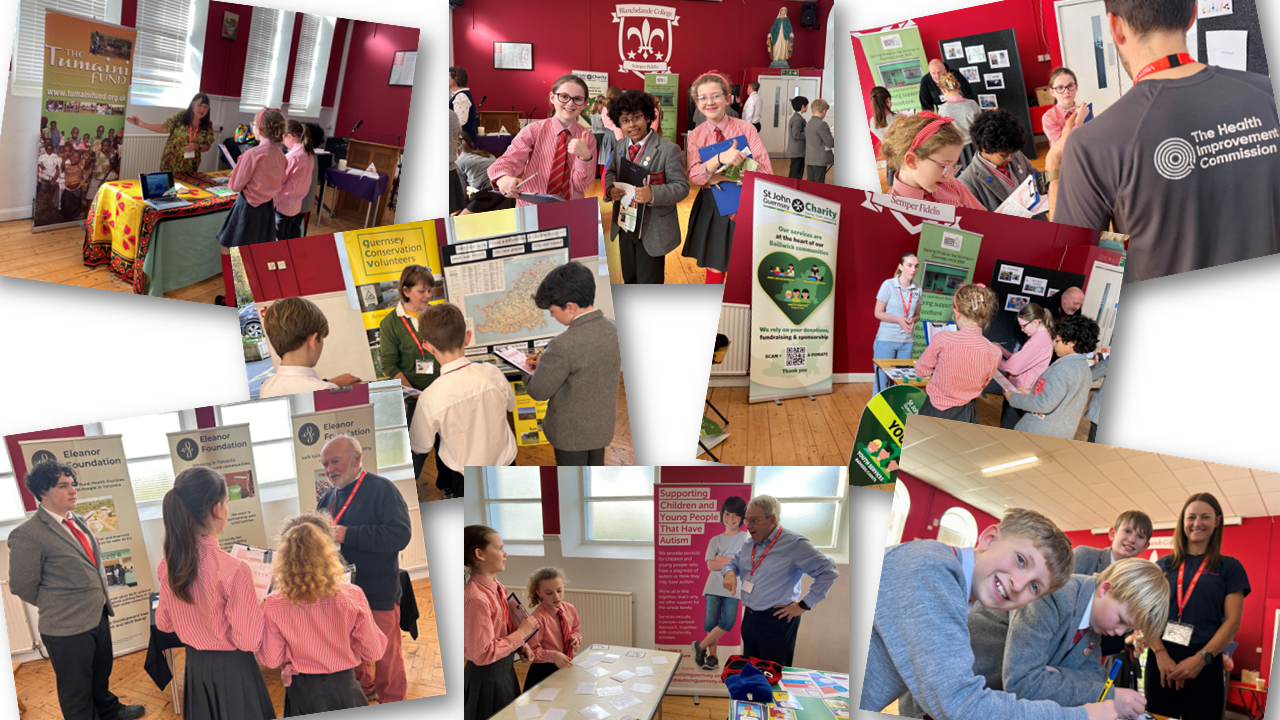
Year 6 students are preparing for their Campaign week, which follows a highpoint in their Heroic Inquiry Journey, namely, the annual Changemakers Fair. I will let Jenny elaborate, but wanted to share a snapshot of this special event, which is as engaging for the students as it is for the local charities involved. I share below the Library news blog post about the event (see here for posts tagged “inquiry”).
—
Last week Friday changemakers from 8 different local charities and organisations participated in our annual market-place event to inspire Year 6 to become changemakers themselves. Having already completed work in Science, Maths, English, Religious Studies and ICT, Year 6 are just beginning the phase of their Signature Work inquiry where they design and run campaigns to change their community for the better. This is a very practical opportunity to put Catholic Social Teaching into practice as they take action inspired by their chosen causes. Amy Woollaston, the Active Travel Officer from The Health Commission commented “It was a pleasure to attend this event at Blanchelande College that encourages young people to grow into socially and environmentally conscious citizens, deepening their empathy and their understanding of the vital work done by Guernsey’s local charities.” Dr Susan Wilson, Founder and CEO of the Tumaini Fund added, “this is a wonderful event and it is such a joy to be included.” Year 6 did an amazing job engaging with all the different stands, and many of the visitors commented on how engaged and well-prepared they were. Well done Year 6!
 30th March 2026 at 9:26 am in reply to: Discussing Education, Libraries and FOSIL With Elizabeth Hutchinson #89745
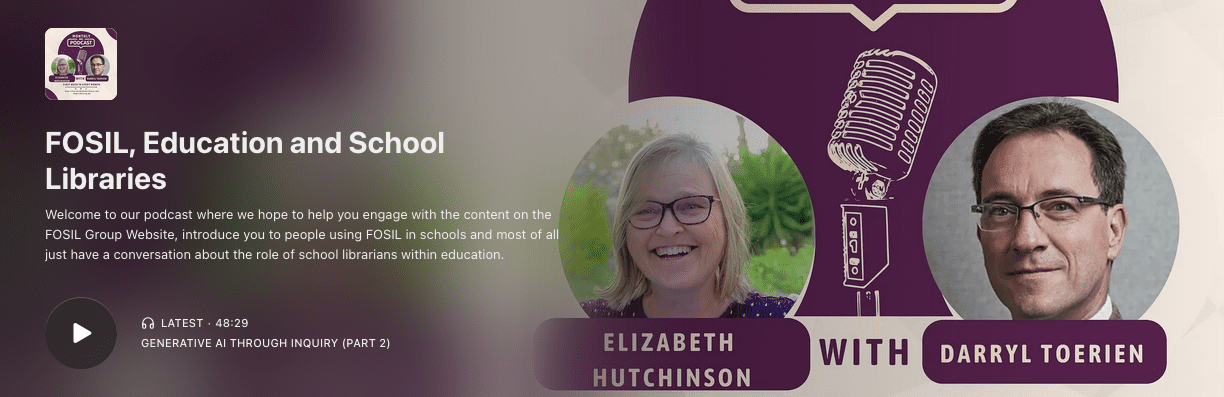
Episode 23 of FOSIL, Education and School Libraries is now available: Generative AI Through Inquiry: Part 2: The place and role of AI in Inquiry.
In this Episode, we discussed GenAI in relation to the Connect stage of the FOSIL Inquiry Cycle, and will do so in relation to Investigate and Construct in the next Episode.
—
 27th March 2026 at 11:46 am in reply to: Learning to predict the future by inventing it – TeenTech Awards #89668
Hello, Jannath — I am sorry that I missed replying to you here.
I never managed to align our Year 9 Signature Work Inquiry with the TeenTech Awards this year, mainly because our timetable changed substantially (see this post in Year 9 (Grade 8) Interdisciplinary Signature Work Inquiry @ Blanchelande College). However, I have ideas for next year that I will share here once I know whether the format will remain unchanged, or not.
Additionally, having now run the TeenTech Awards twice as a weekly 45-minute Scholars’ Society Activity (see here in Library news), we have some very clear ideas about how to do this even better next year, which I will also share here in due course.
In the meantime, we have just submitted our Innovation Logs for this year’s Awards (see below from Library news):
—
Our TeenTech Scholars have wrapped up a busy term by submitting their Innovation Logs for the national qualifying round of the highly competitive TeenTech Awards.
Innovation Logs, which detail the development of their ideas to make the world a better place to live in, can be up to 15 pages long. This year we have 15 students in Years 7-9 competing in 8 Teams, who between them averaged 14 pages / 2,798 words per Innovation Log. This is an extraordinary achievement, given the exceptional quality of their work—for perspective, the Year 10 HPQ research report is 2,000 words.
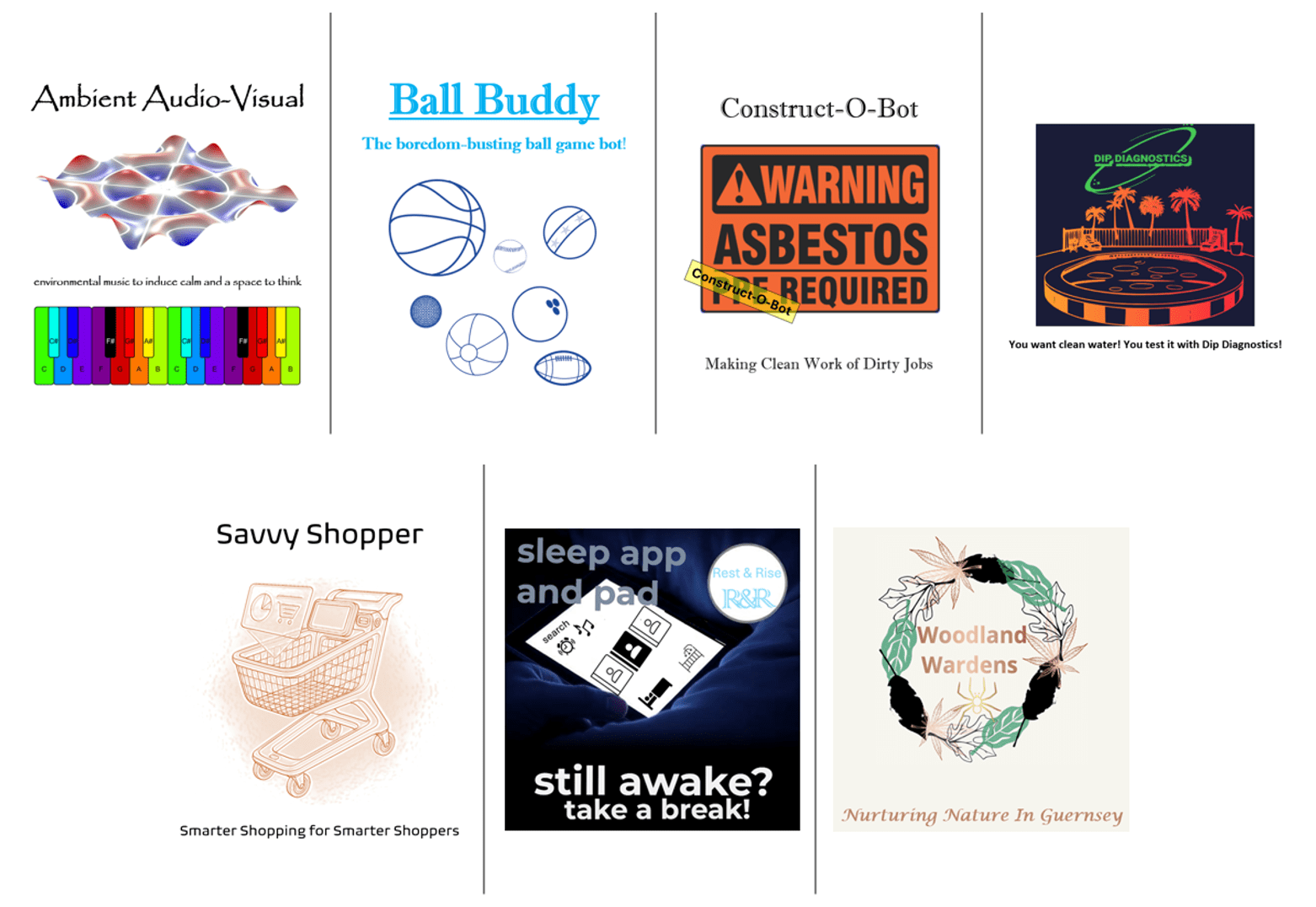
This year’s submissions are:
- Ambient Audio-Visual (Matthew in Y7 & Genevieve in Y8) | Ambient Music audio-visualised as environment for inducing calm and a space to think.
- Ball Buddy (Isabella & Isla in Y7) | An interactive robot that can play a variety of ball games, particularly aimed at children who have no-one to play or train with.
- Construct-O-Bot (Dexter & Felix in Y7) | Construction robots designed to work alongside humans providing support with dangerous, difficult or unpleasant tasks such as clearing asbestos.
- Dip Diagnostics (Jake in Y7 & Alexander in Y8) | A cheap and easy-to-use test for bacteria in swimming pool water.
- Hydraband (Sienna in Y9) | A stylish, low-cost wearable device for the biometric tracking of dehydration levels and incentivising hydration.
- Savvy Shopper (Alice, Effie & Lucia in Y7) | A smart shopping trolley that utilises RFID technology to adapt to different shopping styles and needs, including an edutainment mode for shoppers with young children.
- Sleep Pad (Henrietta in Y7) | A tablet-style device with accompanying app to help children to develop and maintain healthy sleep habits.
- WoodlandWardens (Edouard & Reuben in Y8) | A spider-like robot whose primary function is to survey trees and report on their health and structural integrity in order to minimize costly storm damage. More broadly, a suite of robots with different shapes adapted to different kinds of woodlands and forests.
Should any Teams progress through the qualifying round, they will compete in the Final at the Institution of Engineering and Technology (IET) in London at the end of June. While we are hopeful for a return to the IET—following rEcycle and Co‘s success last year—and wish our Scholars well, we are all in agreement with Richard Feynman that
the [real] prize is the pleasure of finding the thing out, the kick in the discovery.
—
 21st March 2026 at 12:44 pm in reply to: Discussing Education, Libraries and FOSIL With Elizabeth Hutchinson #89619
I can’t believe that it has been over a year since I updated this, but so much has happened since then, which is partly why…
To update, starting with the post above:
The inaugural FOSIL Symposium on Saturday 8 February 2025 — hosted online by Elizabeth, and in-person by Blanchelande College Library — was an extraordinarily uplifting experience, with more than 200 colleagues from around the world joining speakers from around the world for a day-long celebration of enabling our students to develop as engaged and empowered inquirers.
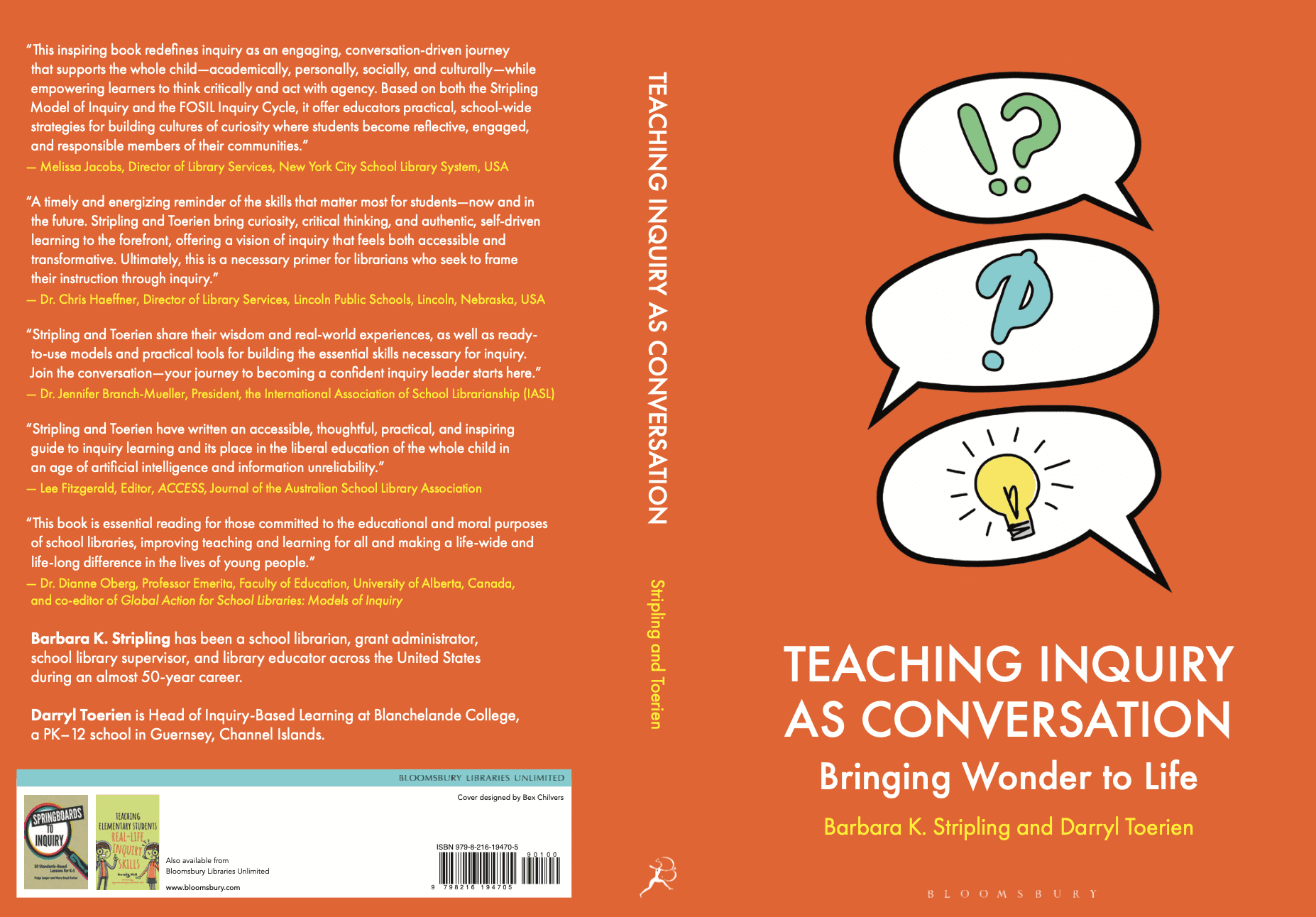
Teaching Inquiry as Conversation: Bringing Wonder to Life, co-authored with Barbara for Bloomsbury, is due to published on 14 May (online) and 11 June (print).
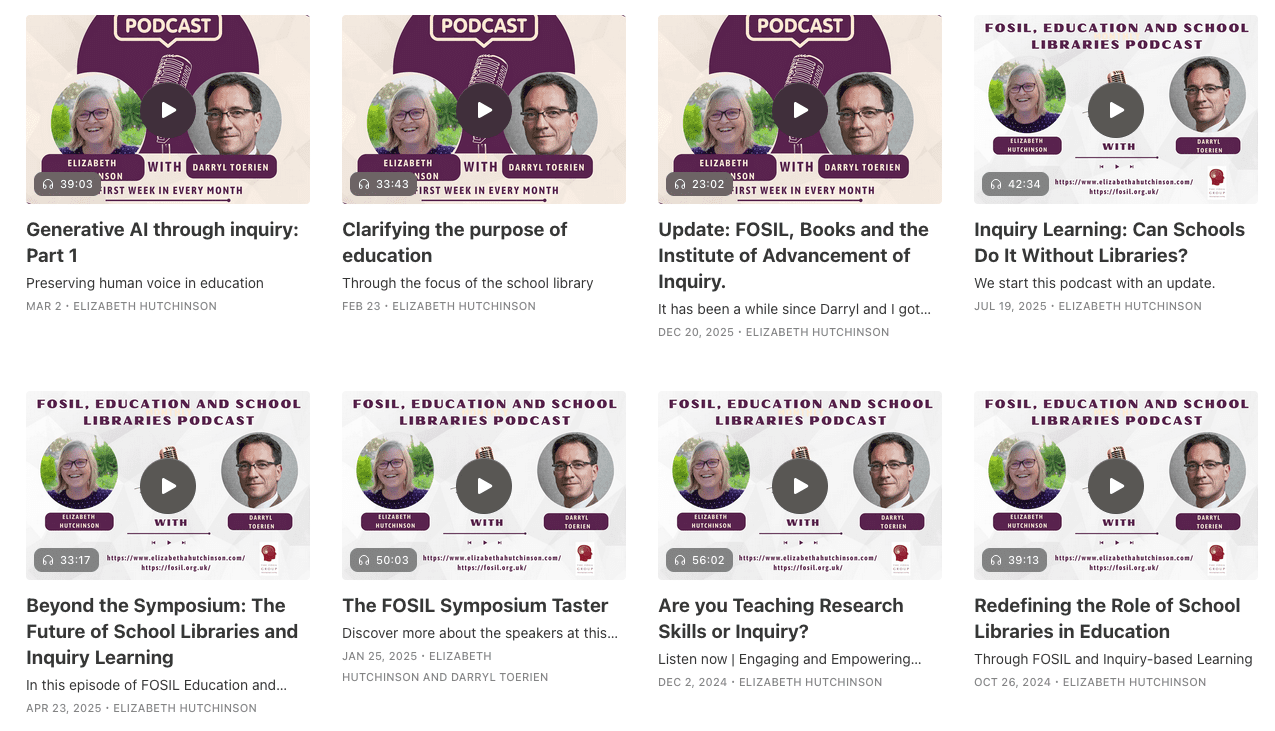
Since Episode 17 of FOSIL, Education and School Libraries — The FOSIL Symposium Taster — we have recorded:
- Episode 18 | Beyond the Symposium: The Future of School Libraries and Inquiry Learning (April 2025)
- Episode 19 | Inquiry Learning: Can Schools Do It Without Libraries? (July 2025)
- Episode 20 | Update: FOSIL, Books and the Institute of Advancement of Inquiry (December 2025)
- Episode 21 | Clarifying the purpose of education through the focus of the school library (February 2026)
- Episode 22 | Generative AI through inquiry: Part 1: Preserving human voice in education (March 2026)
I met with Elizabeth this morning (Saturday 21 March) for Part 2 of Generative AI through inquiry, and will add that here as soon as it becomes available.
 13th March 2026 at 3:07 pm in reply to: Year 9 (Grade 8) Interdisciplinary Signature Work Inquiry @ Blanchelande College #89616
This academic year, we switched from 35-minte lessons to 50-minute lessons. This meant that the timetable was not able to accommodate the Signature Work as a separate subject, which was re-embedded in English, with a time-tabled allocation of one lesson and one homework per week. This, in turn, necessitated refining the Signature Work while also redeveloping it. This new format also meant that we were ready for the English speeches by the end of February, rather than the end of June, and we celebrated the Signature Work on Monday evening, 9 March.
While there is much to share about refinements to this Signature Work, and important insights gained, I am pressed for time at this moment. However, the celebration was extraordinary, and I share below the Library News blog post about the event, and my PPT presentation (with notes on slides 3, 11 and 21).
—
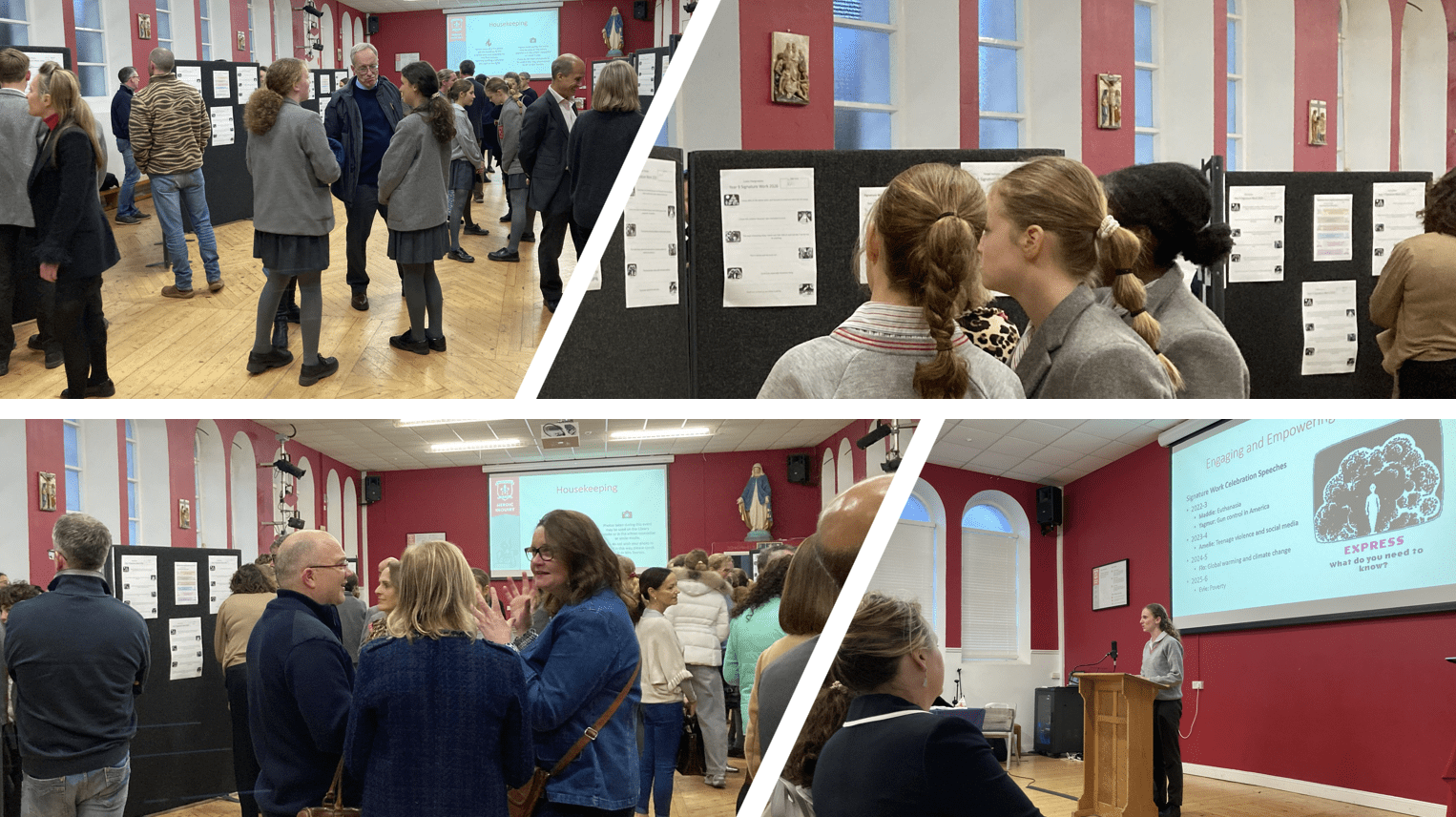
On Monday 9 March, we celebrated the conclusion of the Year 9 Signature Work Inquiry, which is an independent exploration of a topic related to the theme of Planet Guernsey: Living Well in a World Worth Living in. The Signature Work, which is framed through the United Nations Sustainable Development Goals, is embedded in English, develops curricular links with Geography and Theology, and culminates in a presentation that includes a substantial written and spoken component. The spoken component serves as final preparation for their GCSE English Language Speaking and Listening assessment, which students complete in Year 9. The Signature Work also serves as essential preparation for the inquiry-based Higher Project Qualification (HPQ), which students may apply to do in Year 10, and which counts as half a GCSE.
As is customary, one student was chosen to deliver their speech to parents and guests on behalf Year 9, which is always a highlight of the evening. This year, Evie powerfully addressed the problem of poverty in a speech that was all the more thought-provoking and challenging for being so quietly-impassioned. The other highlight of the evening is the opportunity to discuss their Signature Work with students, which is summarized in a poster. Students will be delighted to know that Mr Miller, Head of History, who attends the Celebration each year, remarked on the impressive depth of thought that had gone into this year’s posters.
Well done to Evie and all of Year 9 for embodying the joy of independent learning, and for giving voice to “the cry of the earth and the poor” (Pope Francis in Laudato si’).
 28th October 2025 at 9:49 am in reply to: SJSU 2025 | Leap 2 | Teaching Inquiry as Conversation #87920
Unfortunately, I was not able to make it across, but Barbara said that the presentation was very well received, and that all the sessions were very good.
Like with Leap 1, I hope that they will make the proceedings available online, which I will share here if they do.
For an informative overview of Leap 1, see Leap into the Future of School Libraries International Conference by Charlene Petersen for the Canadian School Libraries Journal.
27th October 2025 at 3:09 pm in reply to: SJSU 2025 | Leap 2 | Teaching Inquiry as Conversation #87918Our presentation — Teaching Inquiry as Conversation: Brining Wonder to Life — is now available as a free PPT download.
—
 24th June 2025 at 1:08 pm in reply to: Year 9 (Grade 8) Interdisciplinary Signature Work Inquiry @ Blanchelande College #86956
On Thursday, 19 June, we held our third annual Year 9 Signature Work Inquiry Celebration.

As I explained to parents, the Signature Work poster is similar to an article’s Abstract, in that it both summarises a larger body of work and reflects a learning journey that is itself embodied and situated.
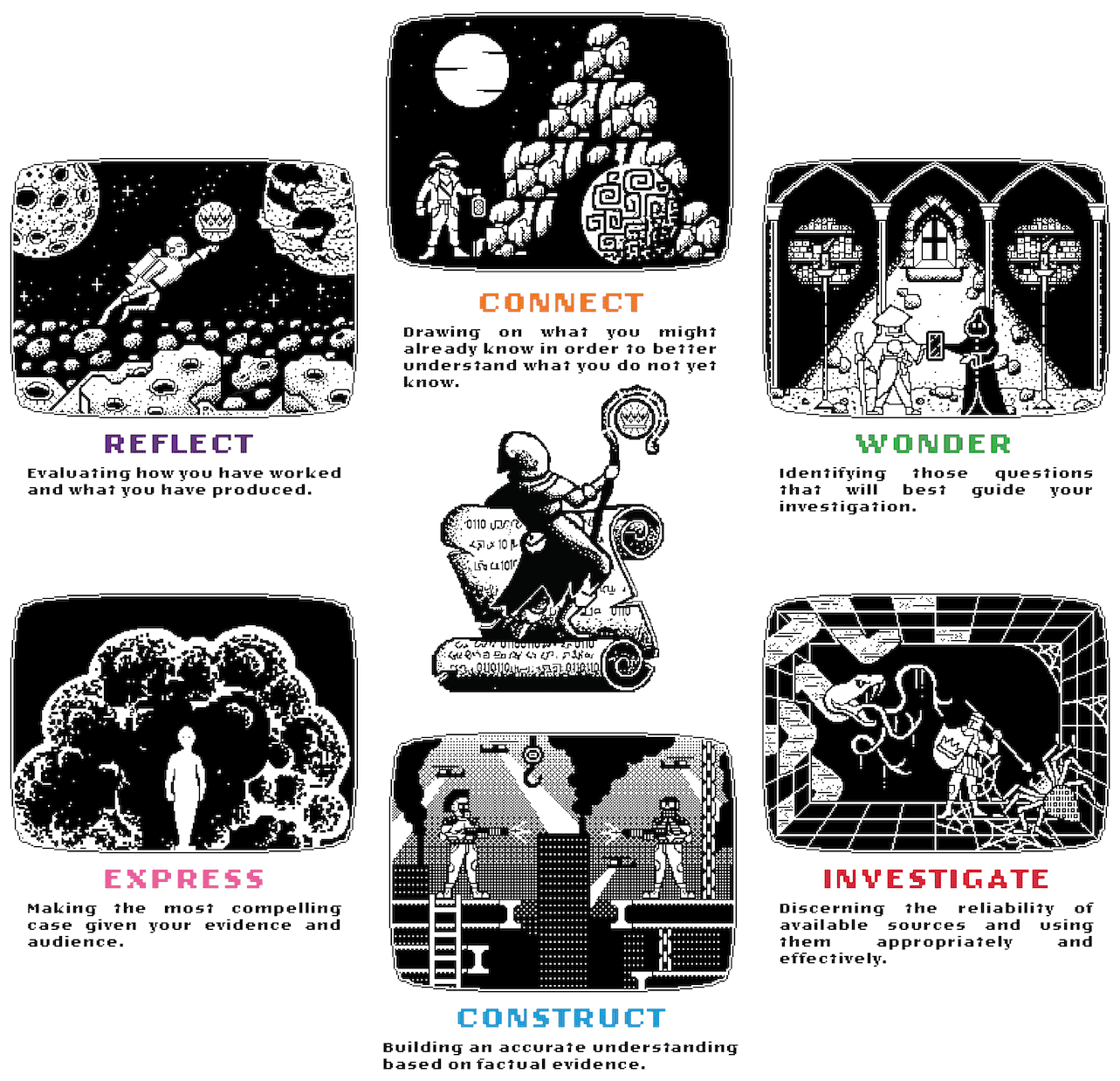
This year I gave parents an overview of what this learning journey entailed: deeply thoughtful reading into a personally-chosen topic related to the theme; a 1-minute speech in English; a 2-minute speech in Geography; a 750-word essay plan overview; an essay plan; a handwritten draft essay; a typed re-draft; a typed re-draft in response to feedback, and; cue cards for the 5-minute speech in English.

As is customary, one student was chosen to represent Year 9 with their speech, and this year we could not be prouder of Flo.

 24th June 2025 at 11:42 am in reply to: Year 2 (Grade 1) Signature Work Inquiry @ Blanchelande College #86951
On Wednesday, 18 June, we held our second annual Year 2 Signature Work Inquiry Celebration.
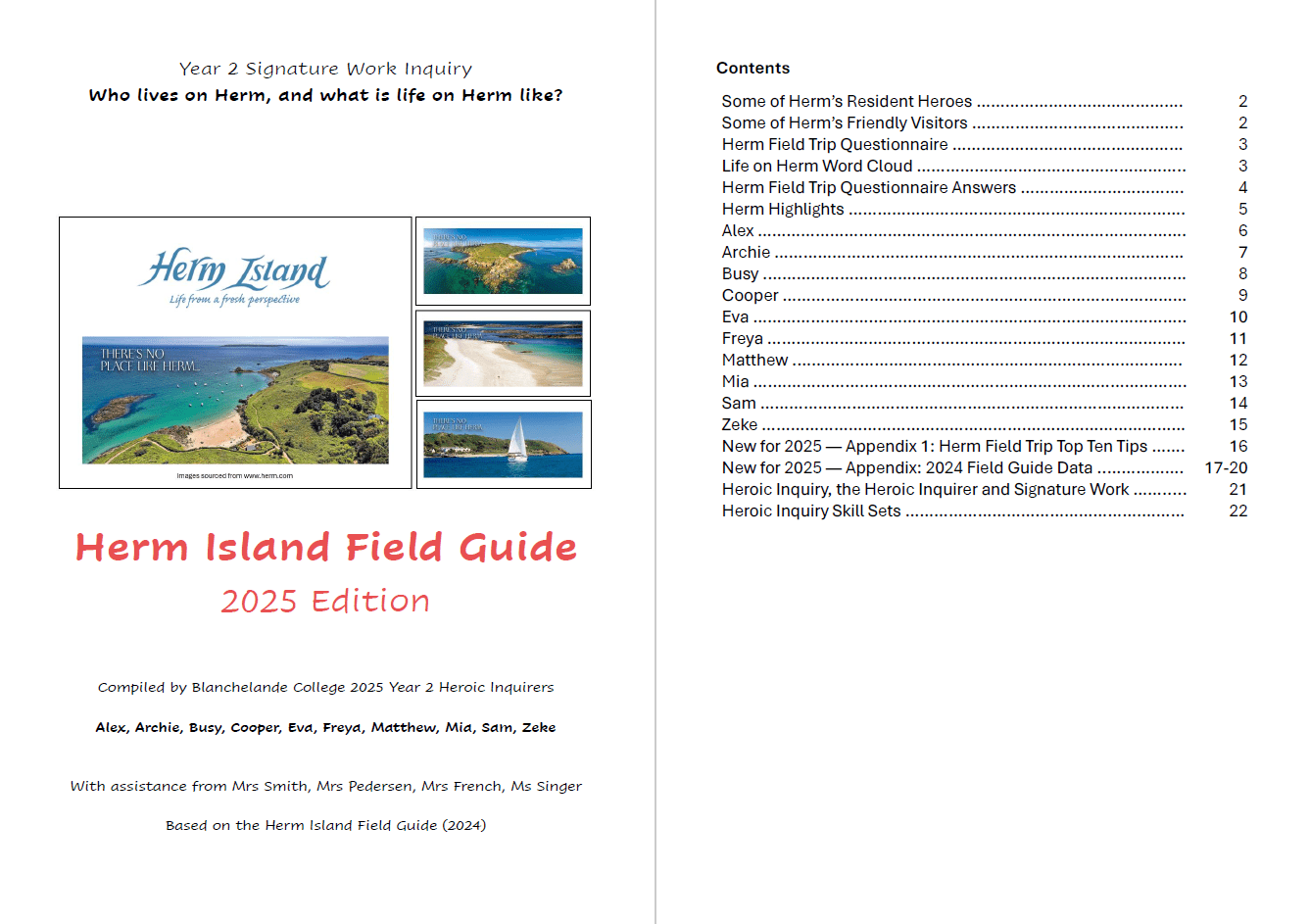
Herm is a very special place, made more so by the very special people who live and work there, and the purpose of the Year 2 Signature Work Inquiry is to build knowledge and understanding of what life on Herm is like, for both residents and visitors.
We were delighted to be joined by Shaun McDonald, General Manager of The White House Hotel, and Alison Veitch, Head Chef.

I realise now, to my shame, that I did not share highlights from last year’s Field Guide; however, I share highlights from this year’s Field Guide instead. The Field Guide is published by the Library and presented to staff and students who took part in the Field Trip, as well as the residents who we met.


Thanks, Ruth and Elizabeth.
I’ve just read a very interesting article by Peter Michael Gratton, called The Banality of Complicity: Arendt’s Guide to Moral Resistance in the Age of Trump, in which he discusses Hannah Arendt’s Eichmann in Jerusalem: A Report on the Banality of Evil (1963) and subsequent lecture in 1964, Personal Responsibility Under Dictatorship.
Gratton observes that Arendt’s lecture “is uncanny in precisely identifying the psychological and moral patterns of capitulation [to] and cooperation [with authoritarian systems] we see playing out today,” and it struck me that there are parallels with the uncritical and wholesale embrace of AI. For example:
Equally troubling [to the alarming speed with which moral standards can be inverted overnight] is Arendt’s insight into how readily people surrender individual judgment to systems. … The lecture isn’t [however] some grandstanding harangue about the need for heroism. Instead, she makes clear that resistance begins not with heroic action but with the simple refusal to participate in the regime and its lies, as well as the comfortable self-deceptions that make complicity possible. … Having knocked down the last of the excuses of the complicit—what else was I to do?—Arendt can move to the central claim of the lecture: that “obedience” always amounts to support, no matter what we tell ourselves to sleep at night. … What makes Arendt’s [lecture] so profound is that she locates resistance not in grand gestures requiring extraordinary heroism, but in preserving one’s capacity to think independently and refuse complicity in evil even when everyone else has capitulated. We cannot control the circumstances we inherit—so many never asked for this—but we always retain the power to withhold our support from systems that violate human dignity. And in that vital first act of defiance lies the seeds for resisting the reality in which we find ourselves today.
Edit:
I would say that reality is what we have to deal with, and that success is dealing with reality, which is not to say that dealing with reality doesn’t alter the reality we have to deal with.
From the conclusion to my article, “the revolution, and the unfolding resistance that must now precede it, will not be televised brothers and sisters, because the revolution will be live.”
11th March 2025 at 3:05 pm in reply to: Year 9 (Grade 8) Interdisciplinary Signature Work Inquiry @ Blanchelande College #85777In Defence of the Essay
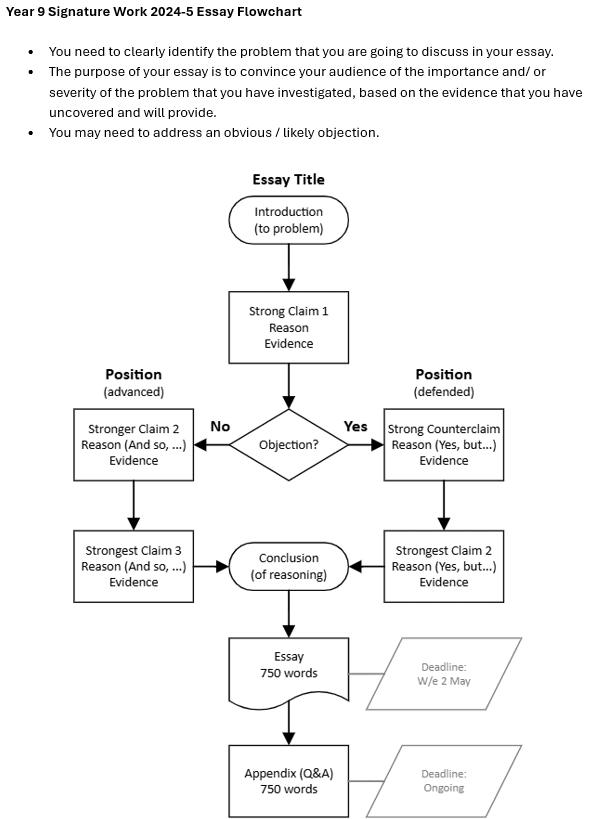
We have reached the point in the Year 9 Signature Work inquiry where we shift our focus from thoughtful reading to thoughtful writing, which will take the form of a 750-word essay in which students will (a) clearly identify and define the problem that they intend to discuss, and (b) attempt to convince their audience of the importance and/ or severity of the problem based on evidence that they uncovered during their investigation and will present in their essay.
Why, one might ask, as some do, teach students to write an essay if AI can write a better essay? Now while there may be more to this question than at first appears, it is, as asked, a question that demands an answer.
The simple answer is that we are not, in fact, teaching students how to write an essay, but to think, with the essay in this case being a tool to think with, and a particularly powerful one at that.
This distinction may seem pedantic, but is, in fact, profound, especially as AI intrudes its way into every aspect of our lives.
As Christopher Newfield (2025) writes:
My root worry about AI has always been that while it was making machine learning better, it was also making human learning worse. I am not alone in this. Teachers, who are responsible for helping students think, were increasingly furious about what AI was doing to the student brain.
A week before ChatGPT was released, Jane Rosenzweig, director of Harvard College’s Writing Center, made what should be an obvious point: “Writing—in the classroom, in your journal, in a memo at work—is a way of bringing order to our thinking or of breaking apart that order as we challenge our ideas. If a machine is doing the writing, then we are not doing the thinking.”
…
I draw several conclusions here.
…
Second, the high-value economic benefits of AI require fully empowered human use of AI as tools. Benefits will depend on society devoting much more effort than it now does to the expansion of human capabilities, rather than seeing technology as rescuing society from the self-inflicted enshittification of its human systems. The rigourous teaching of writing and thinking is more essential than ever.
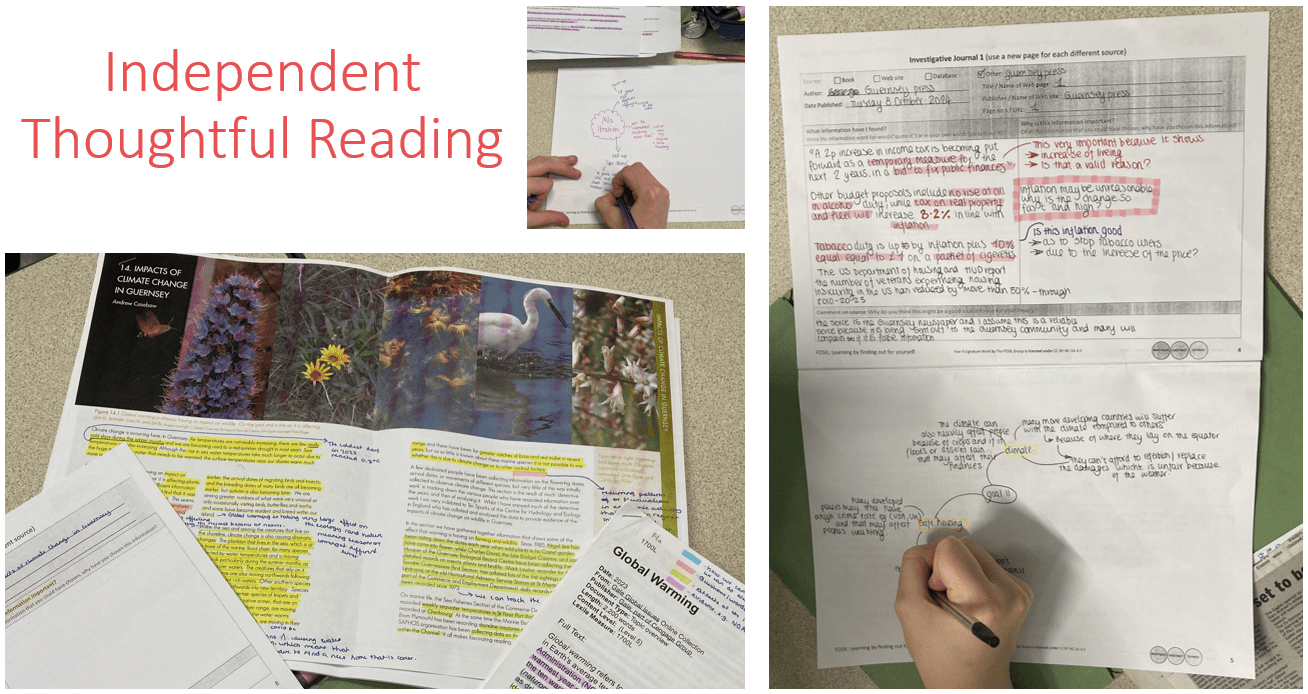
Students have now spent a term investigating a SDG-related problem that they have identified and defined, which is a distinguishing feature of Signature Work inquiry. I have been deeply impressed by how purposefully many students in this cohort have used their Investigative Journals as tools to think with.
The next step, however, is daunting, even for university-level students, which is why there is real value in helping students with this in school. As Newfield (cited above) explains:
I learned during my decades of teaching university-level writing that students can mostly find a general topic that interests them. But they struggle with the next question: what do you want to say about your topic? What’s your thesis, your claim, about it? This stage turns out to be very hard, and the simple reason is that it’s where independent thinking has to happen. It’s where the student diverges, however slightly, from what has already been said. If a GPT product is available, the student—or anyone, myself included—will be tempted to use it to skip this thinking stage.
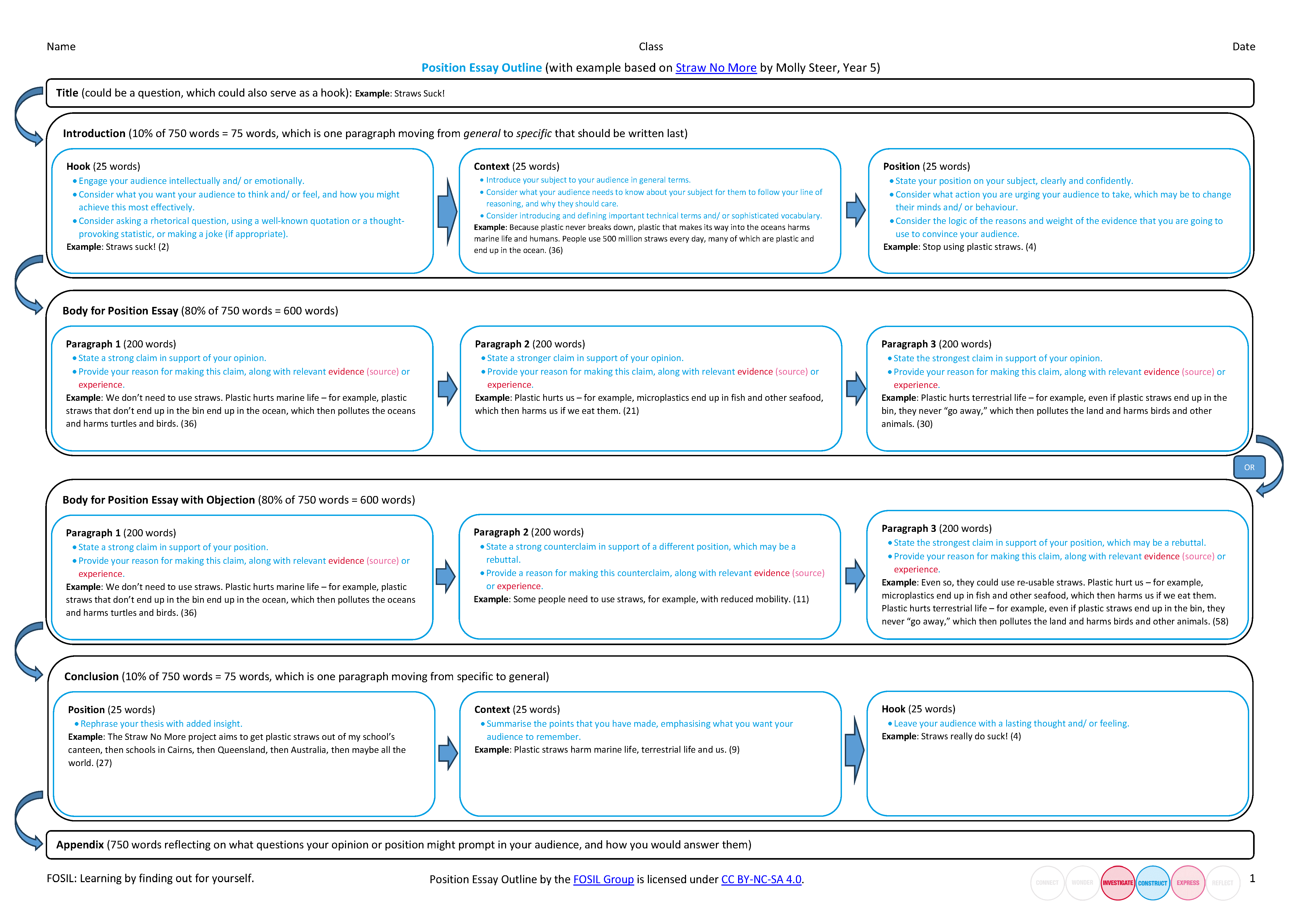
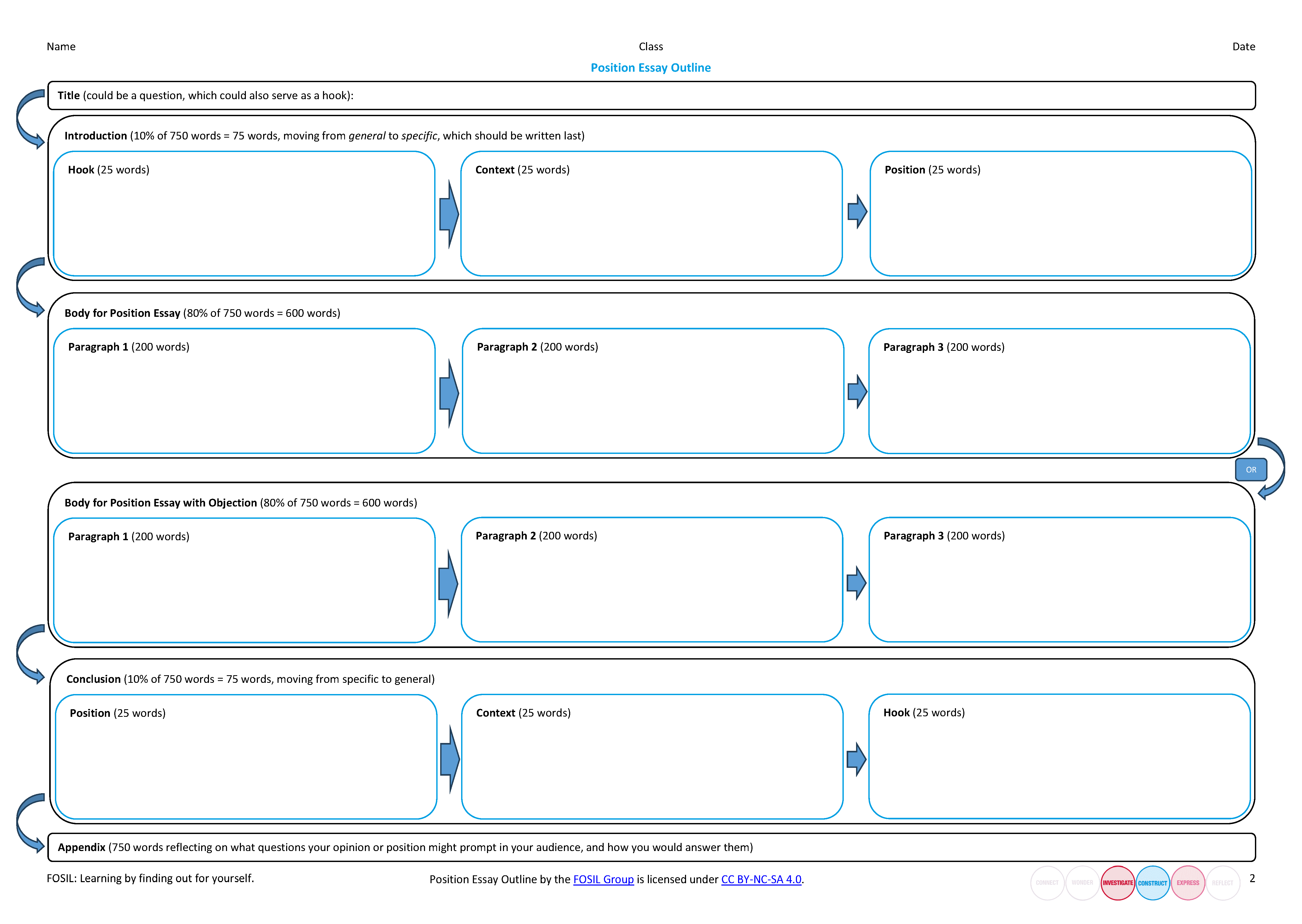
To help students with this last year, I developed the Opinion Essay and Position Essay flowchart and graphic organiser (see post #83043 above). This year I have simplified the flowchart and graphic organiser slightly (see below), and also added an example to the graphic organiser based on the Straw No More presentation by Molly Steer at TEDxJCUCairns (2017), which we looked at in class.
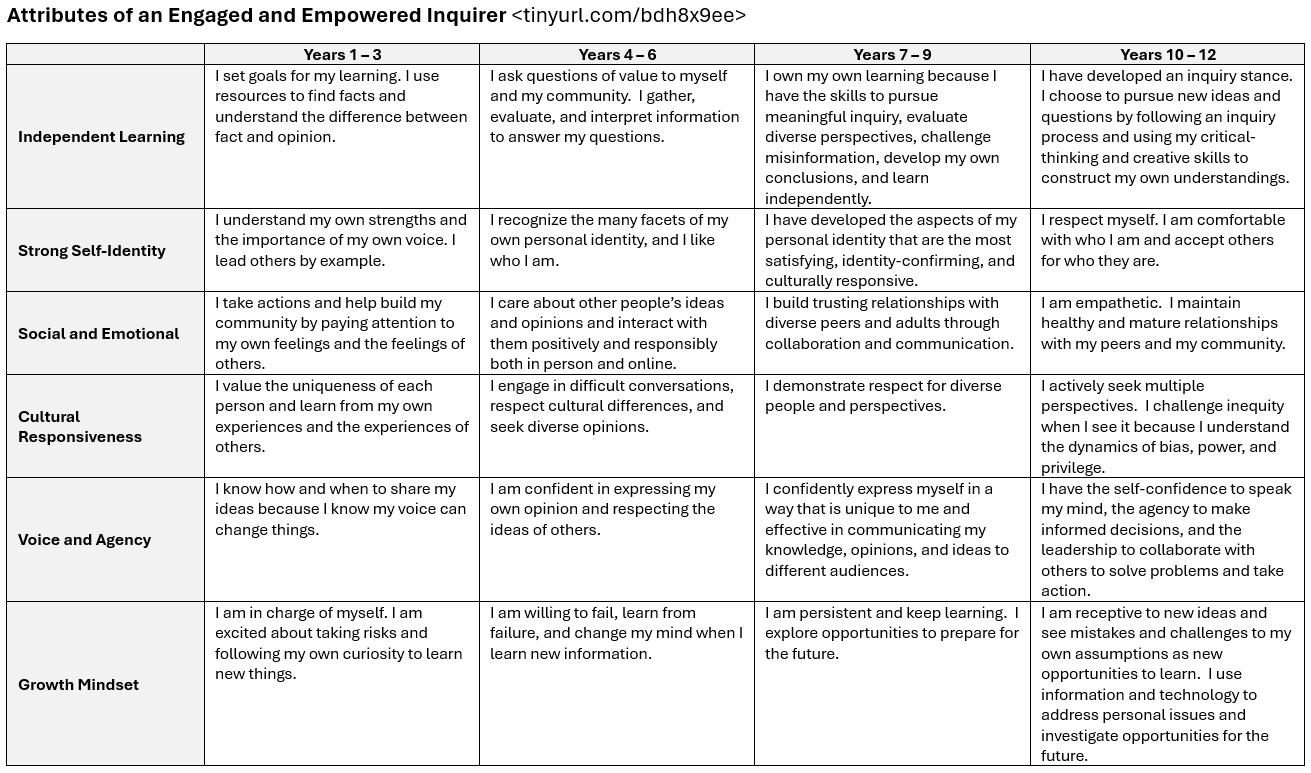
This is the critical moment, as Newfield highlights above, when students become more fully themselves, or less, as they face twofold temptation of letting the machine [and its programmers] think for them and speak for them–as Janet Salmons (2025, emphasis added) warns, “the implicit message [of AI offering to (re)write for you] is less than subtle: use the words we tell you to use, in the style we tell you to use, to say what we tell you to say, in the voice we tell you to use,” which is bringing about a “‘flattening’ of contemporary writing.” This is when I must trust that I have sufficiently “encouraged [my] students to engage in the process of acquiring knowledge, which is a very difficult process, [without which] all you get is memorisation and reproduction in tests” (Young, 2022), or in this case, copy & paste. This encouragement to engage–to Connect–takes time and energy, to be sure, but time and energy well spent on enabling my students to develop as engaged and empowered inquirers, increasingly willing and able to learn for themselves.
My confidence is high.
References
- Newfield, C. (2025, March 4). The Fight About AI. Retrieved from Independent Social Science Foundation: https://isrf.org/blog/the-fight-about-ai
- Salmons, J. (2025, January 28). Finding Your Voice in a Ventriloquist’s World – AI and Writing. Retrieved from The Scholarly Kitchen: https://scholarlykitchen.sspnet.org/2025/01/28/guest-post-finding-your-voice-in-a-ventriloquists-world-ai-and-writing/
- Young, M. (2022, September 21). What we’ve got wrong about knowledge & curriculum. (G. Duoblys, Interviewer) Tes Magazine.
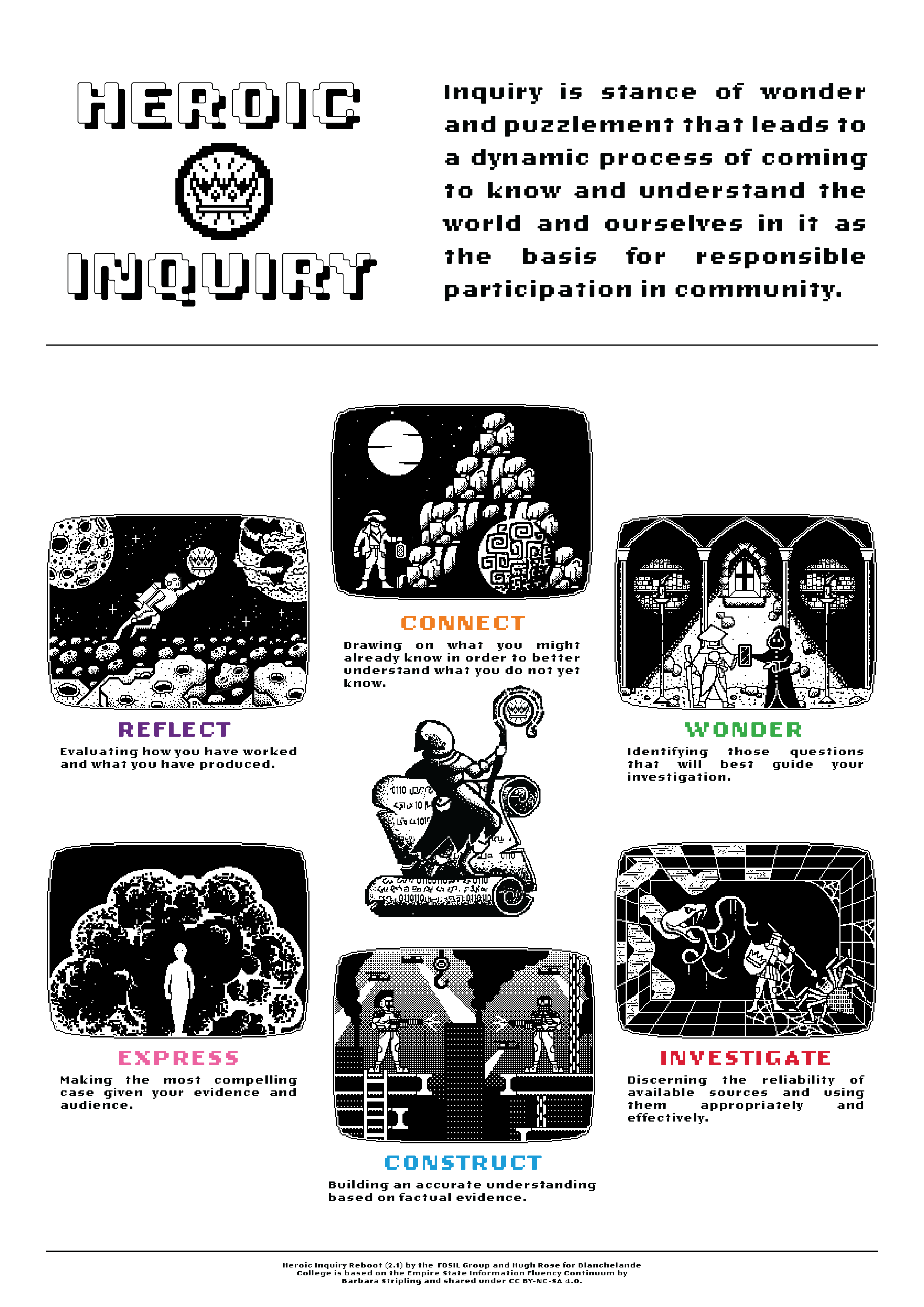
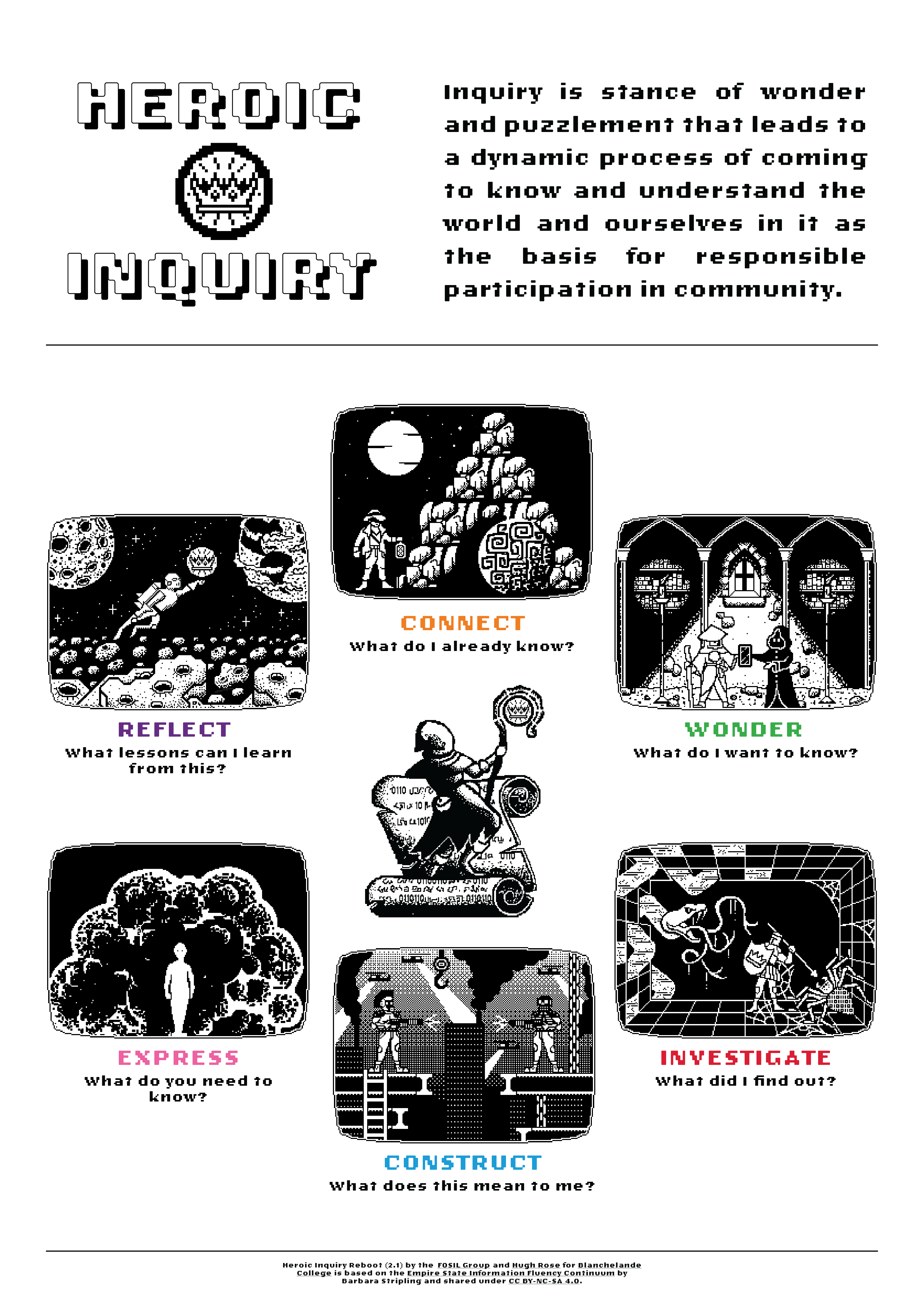
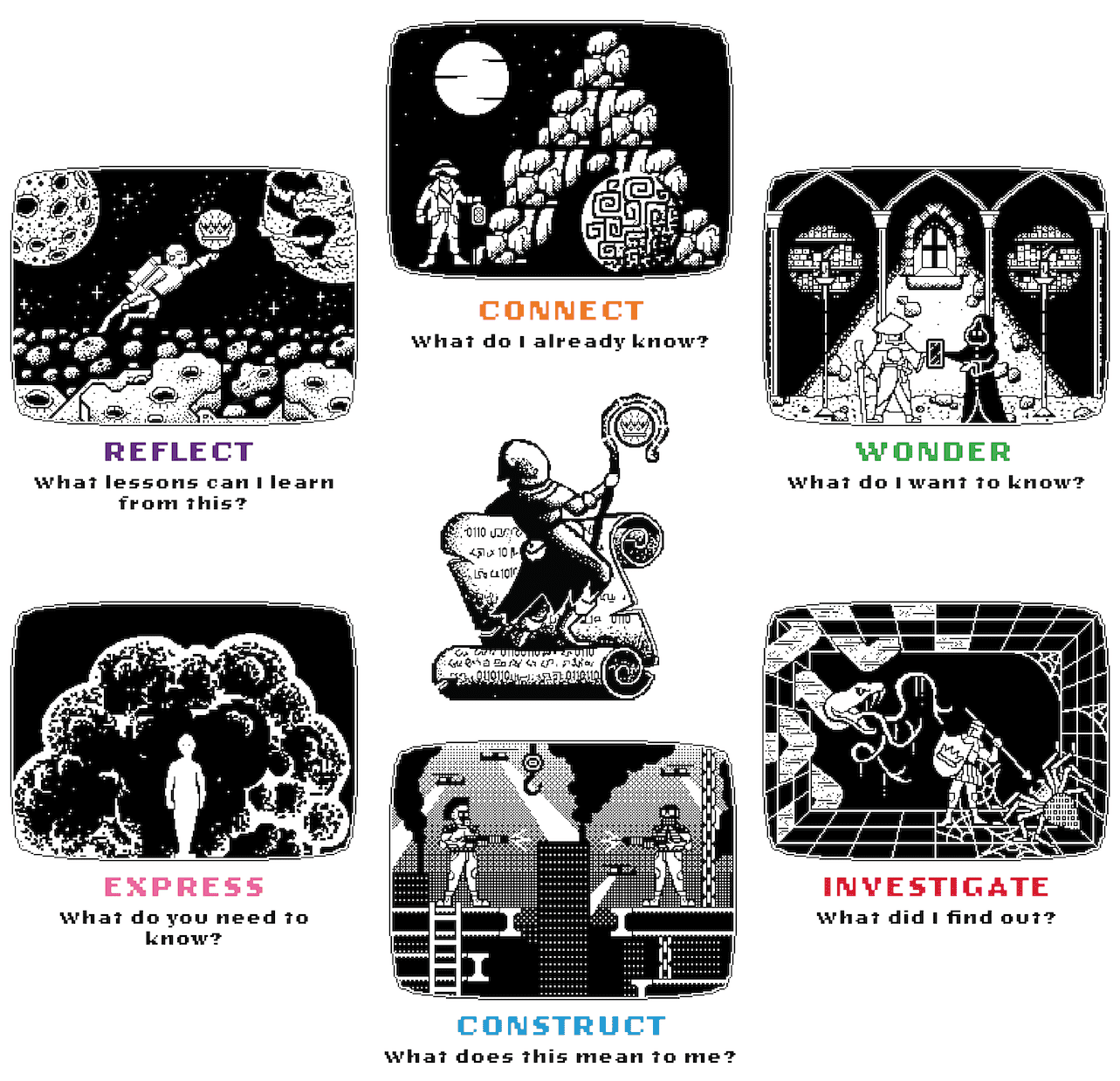
28th February 2025 at 10:35 am in reply to: Session 2b: Darryl Toerien & Hugh Rose (Heroic Inquiry) #85696The CC BY-NC-SA 4.0 stable release of Heroic Inquiry (2.1) is now available for download:
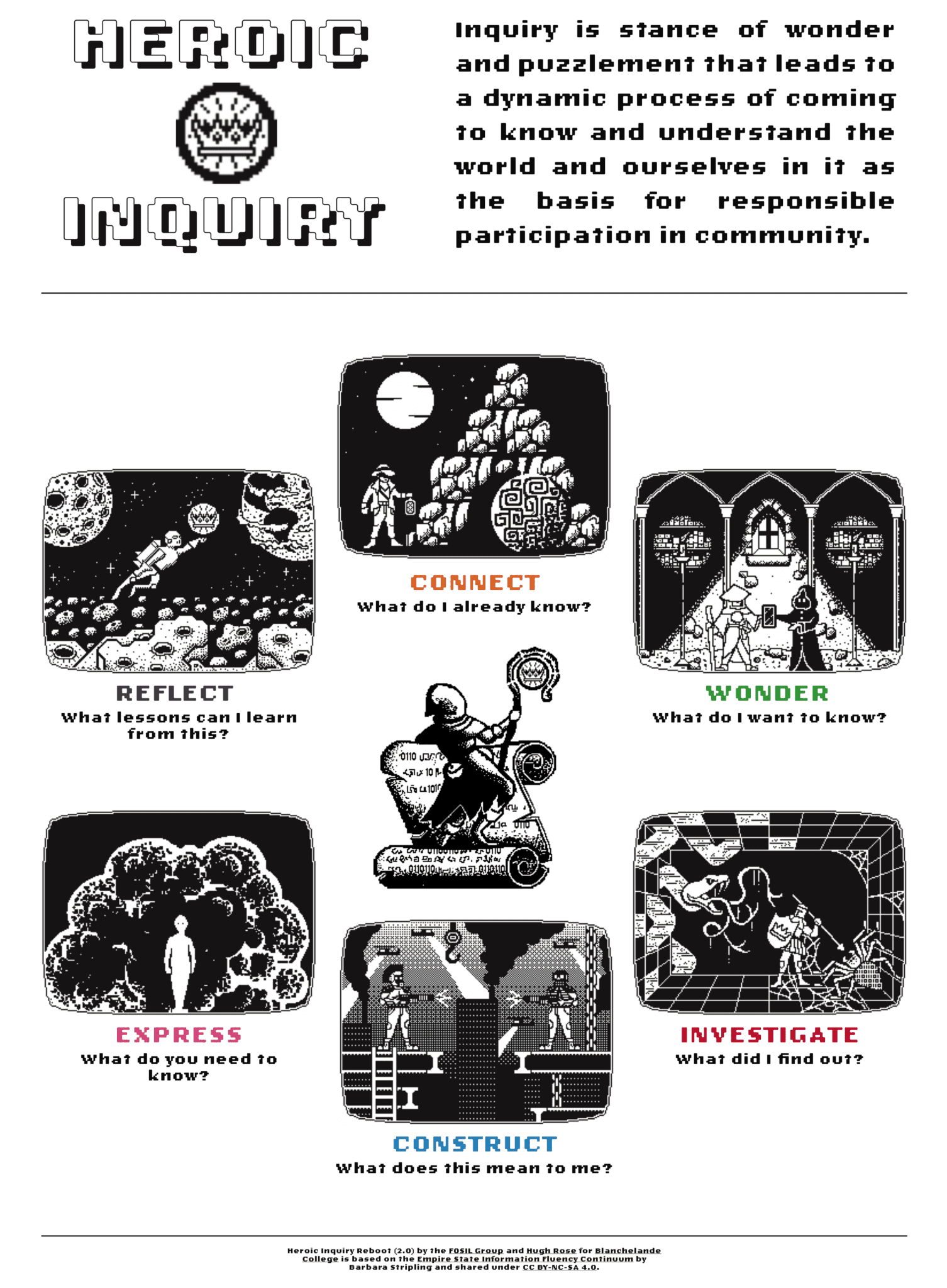
- Heroic Inquiry (2.1) Long stage descriptions | Poster (download PDF or PNG)
- Heroic Inquiry (2.1) Long stage descriptions | Cycle (download PNG)
- Heroic Inquiry (2.1) Short stage descriptions | Poster (download PDF or PNG)
- Heroic Inquiry (2.1) Short stage descriptions | Cycle (download PNG)
The Heroic Inquiry (2.1) icons are also available for individual download:
- 0. Central Heroic Inquirer (download PNG)
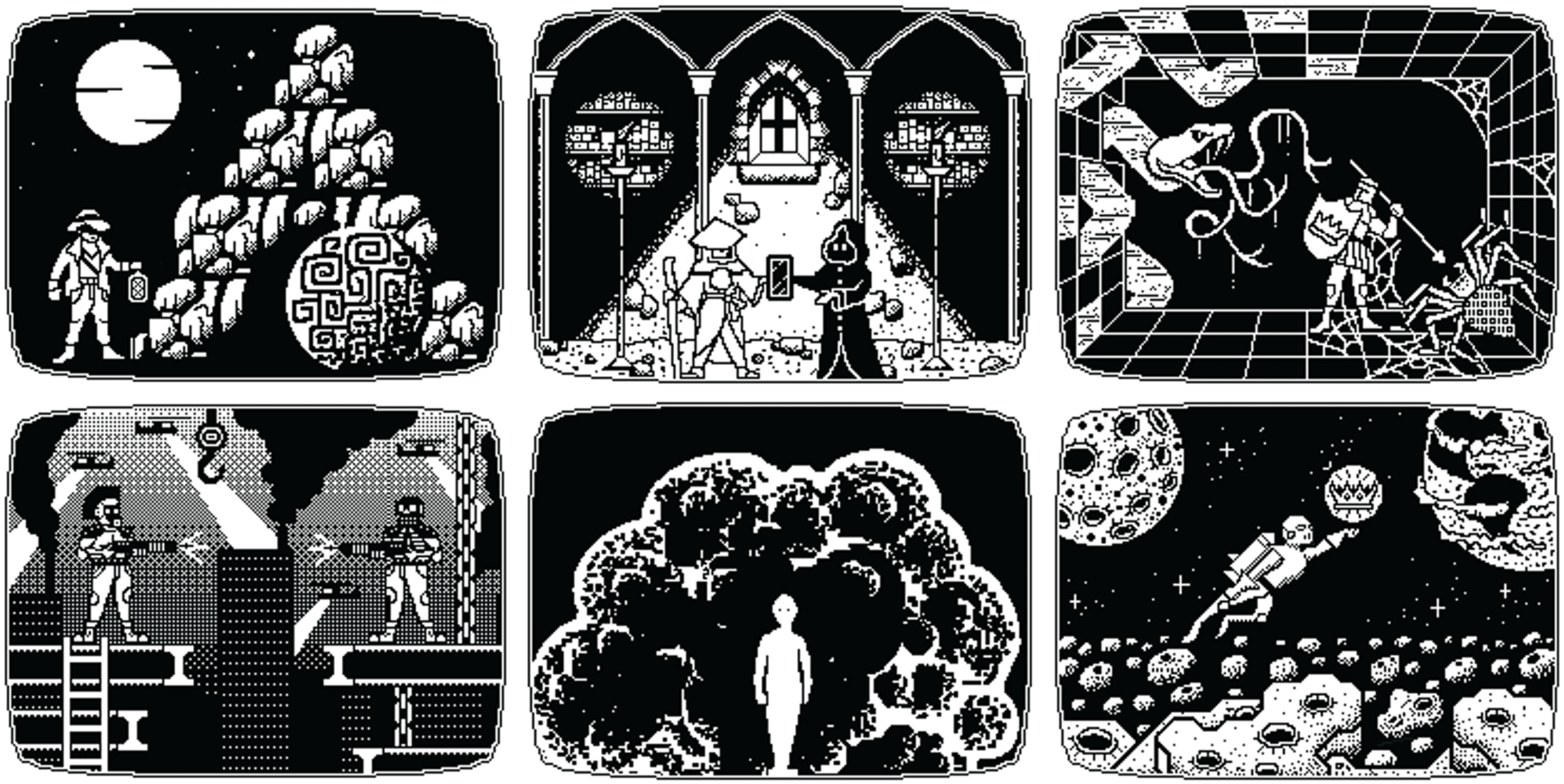
- 1. Connect (download PNG)
- 2. Wonder (download PNG)
- 3. Investigate (download PNG)
- 4. Construct (download PNG)
- 5. Express (download PNG)
- 6. Reflect (download PNG)
—

—
—
—
Heroic Inquiry (2.1) Long stage descriptions | Poster (download PDF or PNG)
—
Heroic Inquiry (2.1) Long stage descriptions | Cycle (download PNG)
—
Heroic Inquiry (2.1) Short stage descriptions | Poster (download PDF or PNG)
—
Heroic Inquiry (2.1) Short stage descriptions | Cycle (download PNG)
 27th February 2025 at 3:25 pm in reply to: Session 2a: Institute for the Advancement of Inquiry (Blanchelande College) #85660
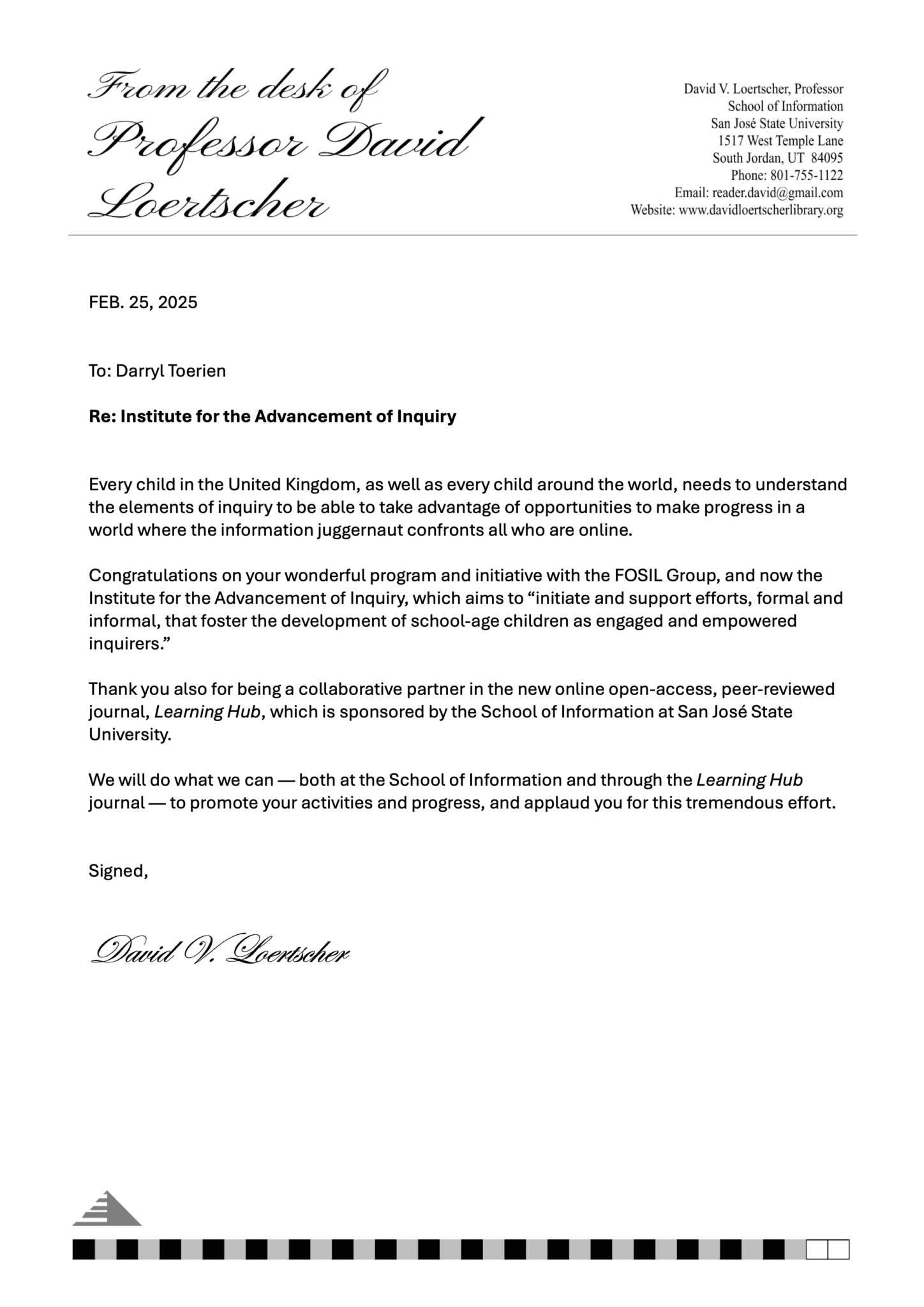
Endorsement received from Dr David Loertscher, Professor at San Jose State University | School of Information.
 25th February 2025 at 10:30 am in reply to: Session 2b: Darryl Toerien & Hugh Rose (Heroic Inquiry) #85654
The stable release of the CC BY-NC-SA 4.0 reboot of Heroic Inquiry (2.1) in Resources is now imminent.
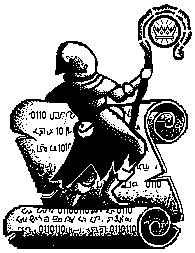
Firstly, the stable release of the central Heroic Inquirer (2.1) has the Heroic Inquirer’s left hand reaching over the top of the scroll/ record, suggesting more active use of the scroll/ record to engage in the Heroic Inquiry process.
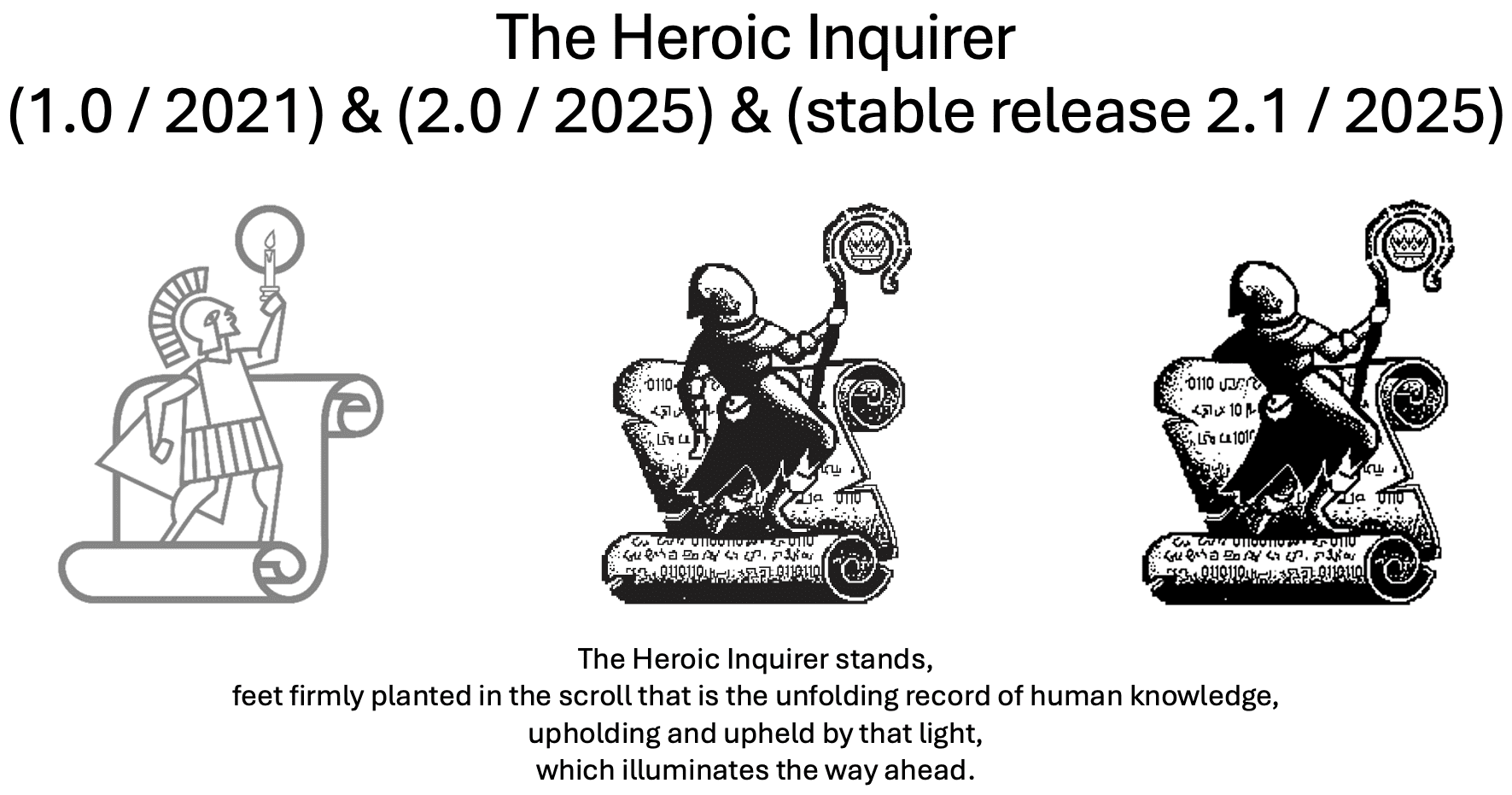
Secondly, the stable release Heroic Inquirer (2.1) has been incorporated into the stable release of Heroic Inquiry (2.1) Short (below) and Heroic Inquiry (2.1) Long. Furthermore, the stage colours are now FOSIL Standard Dark. The posters, cycles and icons will be uploaded to Resources shortly.
-
AuthorPosts